How To Write a Rhyming Children's Book in Perfect Rhyme!

Contents
Anapestic tetrameter, Iambic pentameter, rhythm and meter, perfect rhyme, true rhyme, poetic meter, stressed syllable, word stress, slant rhyme . . . it is enough to make an author's head spin. Thinking about writing a rhyming children's book, welcome to the fray! About fifty percent of the developmental editing I do are rhyming books. Some authors have a great grasp on rhyme and meter, while others could really use a helping hand. So, how do you know which one you are? In truth, the only way to know is to have someone who has never read your rhyming book before read it aloud to you. Are they hitting the rhyme beats (stressed syllables) as expected, or are they stumbling? A good rhyming picture book has a set meter. It’s predictable, like dancing a waltz. You know where each of those steps is going to come. And if you’re wrong, you trip!
But what makes a good rhyming picture book? How do you know when your meter is working? And what type of rhyming children's book works best?
Publishing a rhyming children's book
First things first, let's talk about the elephant in the room. We’ve all heard it said: children's book publishers don’t like rhyming picture books.
Let me set the record straight. Publishers have nothing against rhyming children's books. There are plenty of amazing rhyming picture books out there that have done phenomenally well. Just look at the success of the Llama Llama series or Little Blue Truck . And what parent hasn’t read Chicka Chicka Boom Boom?
So, what's the problem with rhyming children's books? Simple. Too many of them aren’t done well. And while publishers are all for a good rhyming book, what they don’t want is a bad rhyming book: a book with forced rhyme, a book where the meter is off, or a book where the story seems catered to making the rhyme work, rather than the other way around. . . .
None of that means you shouldn't write a rhyming picture book. It just means that if you do write one, you need to make sure the book is done well!
Best picture book themes for rhyming children's books
If you were to look at most of the successful rhyming children's books out there, you would find that they all tend to cover rather simplistic story themes. A day at the farm. A bedtime story. A trip to the grocery store or a meal where a child tries a new food. That’s because the harder your concept is to grasp—the more in-depth it is—the harder it is to relegate it to a few rhyming lines.
A Children's book theme about deep subjects or intense emotions often require more explanation. They need to dive deeper, and that can be hard to do when you’re looking at 10–13 syllables per line. Writing a rhyming children's book can be very restrictive, and it tends to strangle a plot line that has too much depth. Covering deeper subjects can also be hard to do when you are trying to stick to easier words. These heavier subjects usually require the use of more elevated language, and while that is fine in a picture book, it is not easy to make rhyme and meter work properly with long, convoluted words.
So, before you decide to write a rhyming children's book, be honest with yourself about the book. Is it a light, fluffy story? If so, great! Rhyme away. But if it is a complicated story—if it is something that’s going to require deeper explanation—think about whether you could tell the story better without the constraints of rhyme and meter. Odds are, the answer is yes. No matter how much you may like rhyming books, if setting your book as prose will give you a more compelling story that will resonate with readers in a stronger way, it's probably worth doing so.
What is poetic meter?
Poetic meter, also called rhyming meter, is the rhythm of your picture book. It is the pattern of stressed and unstressed beats (or syllables) you follow in your text. Meter is about more than just syllable count. It is also about precisely following the pattern of stressed and unstressed beats on each line (or set of lines).
When writing in poetic meter, it is essential to be consistent when it comes to the number of feet per line. A foot is a set of stressed and unstressed syllables. Take a look at the following anapestic tetrameter example:
I went/ to the store/ to go buy/ a big ham,
Bana/nas and pick/les and straw/berry jam.
These lines stress every third syllable (the red letters), and are broken into four "feet" or sets of stressed and unstressed beats. Each foot is separated by a /.
This kind of rhyming is called anapestic tetrameter. Anapestic meter is a line of poetic verse in which every third beat is stressed. Tetrameter refers to the number of "feet."
Below are the names used for poetic meter based on the number of feet per line:
- Monometer is a line of poetic verse that includes one metrical foot
- Dimeter is a line of poetic verse that includes two metrical feet
- Trimeter is a line of poetic verse that includes three metrical feet
- Tetrameter is a line of poetic verse that includes four metrical feet
- Pentameter is a line of poetic verse that includes five metrical feet
- Hexameter is a line of poetic verse that includes six metrical feet
- Heptameter is a line of poetic verse that includes seven metrical feet (*Iambic Heptameter's a big one in picture books!)
- Octameter is a line of poetic verse that includes eight metrical feet
When it comes to writing a rhyming children's book, there are many different meters you can follow. But the four most commonly used meters are iambic tetrameter, iambic heptameter, anapestic tetrameter and anapestic heptameter.
Iambic Meter
Iambic meter is a line of poetic verse in which every other syllable is stressed. Take a look at the couplet in the iambic tetrameter example below. Stressed beats are in red:
I got a brand-new car today.
I hope they do not make me pay.
Note how both lines start with an unstressed beat and end on a stressed beat. Each has four stressed beats, with a single syllable/beat between them. Here's another example of iambic tetrameter:
Suzy wants to play today.
Should I go, or should I stay?
In this example of iambic tetrameter, both lines start on the stressed beat, but they follow the same pattern as above.
In deciding whether or not a line will start with a stressed beat, keep one thing in mind: an initial downbeat is completely fine and does not affect your meter. It is only once you have hit your first stressed beat that your meter must rigidly follow what you’ve set forth. So, for example, the following couplet in iambic tetrameter is also perfectly fine even though one line starts with a downbeat and the other does not:
Suzy wants to play today.
I wonder what her mom will say.
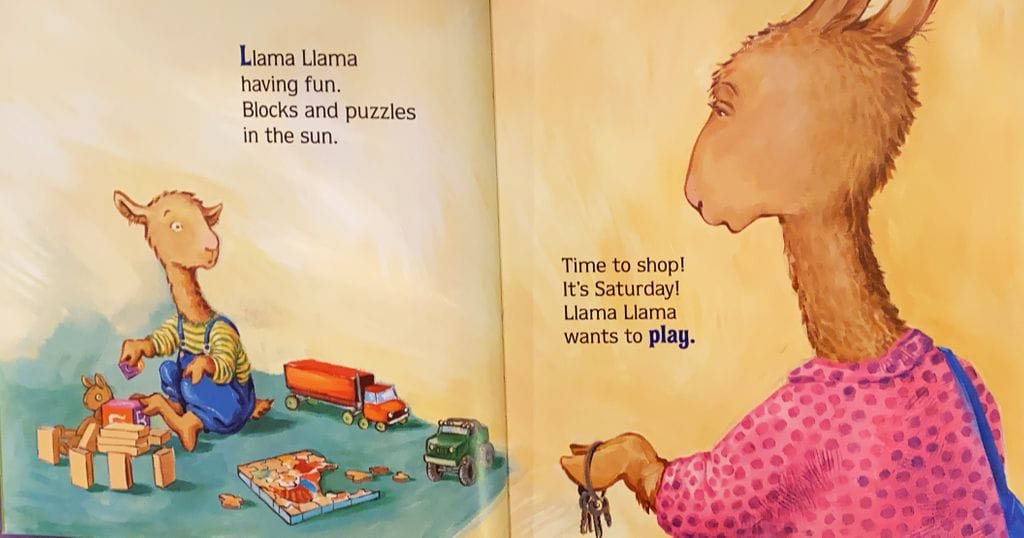
Take a look at this iambic tetrameter example from Llama, Llama, Mad at Mama by Anna Dewdney. As you can see, it follows the same iambic meter as above. It's worth noting here that even though each line technically has two stressed beats rather than four, this still counts as tetrameter because the rhyme falls on the fourth stressed beat. The lines have just been broken in half to better fit the design of the page.
Anapestic Meter
Anapestic meter is a line of poetic verse in which every third beat is stressed. Below is an example of anapestic tetrameter.
The sun went down low and it took all the light.
I rushed off to bed without saying goodnight.
In the example of anapestic tetrameter above, each stressed beat is followed by two additional downbeats/unstressed beats.
As with above, a line can begin with a stressed beat or an unstressed beat. It is only after you hit your first stressed beat that the meter kicks in.
Here's another anapestic tetrameter example:
I’m so excited. I have a play date.
My best bud, Big Tiger, will be here at eight!
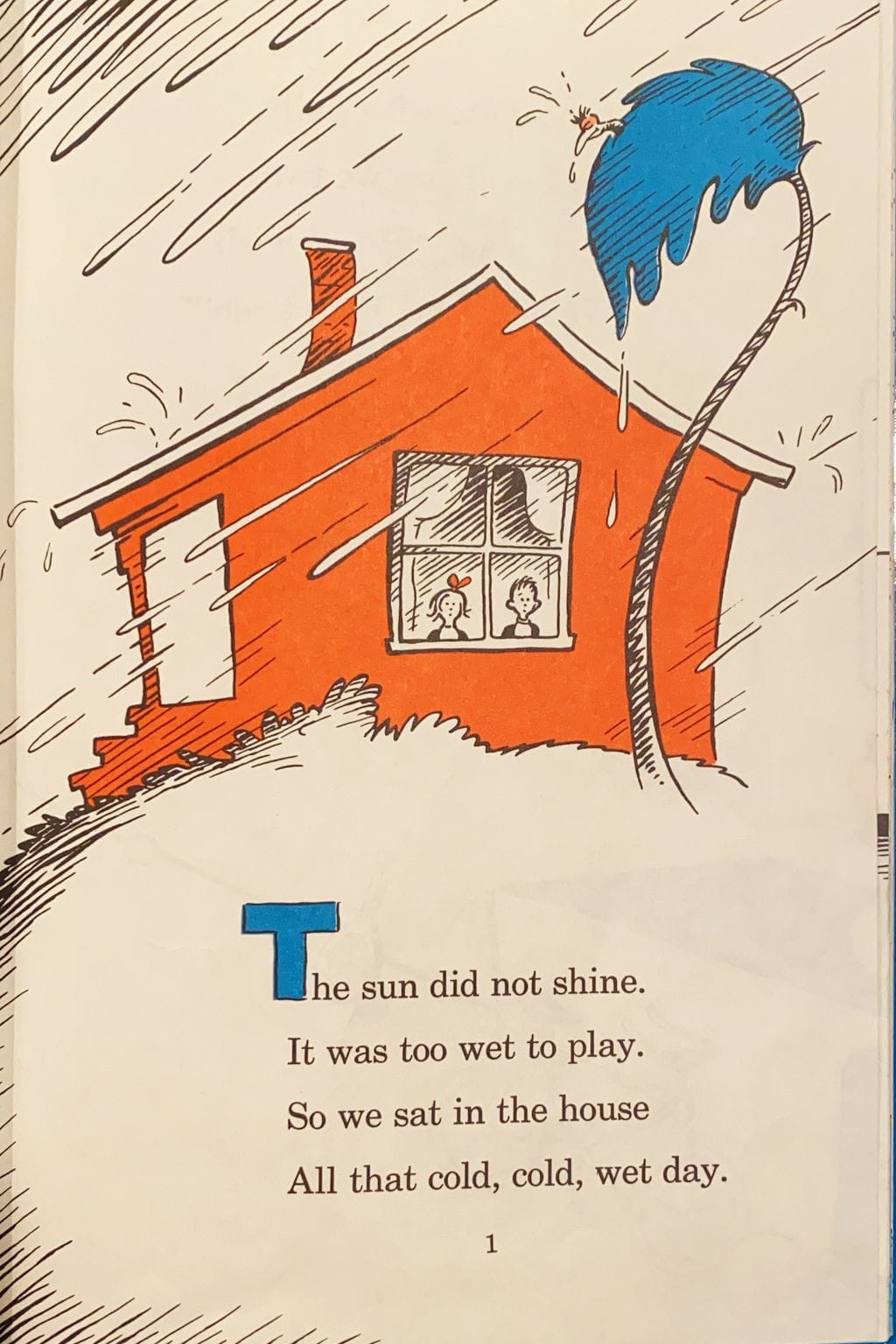
Take a look at this anapestic example from The Cat in the Hat by Dr. Seuss. You can see that it follows the same meter as above:
Why is meter so important?
Children's books are meant to be read aloud. And while we can sometimes overlook failures in meter when we are reading to ourselves, words that are being read out loud simply aren’t as forgiving. In order for a rhyming children's book to work, the meter has to be impeccable. And a big part of that is making the meter predictable. With a book that works well, the reader should be able to glide through the words without stumbling. If they have to look for a new meter with each page turn, they are going to get frustrated. The same is true if the meter is only mostly consistent. Having even one syllable out of place could cause the reader to trip up, which will result in having to reread the text. Doing so ruins the reading experience and can be very annoying to both the reader and the child being read to.
4 tips for writing perfect poetic meter
1. Pick a poetic meter and stick to it
Whether you choose to follow iambic meter, anapestic meter, or some other meter for your rhyming children's book, make sure you stick to it exactly. If you are using anapestic meter, be absolutely sure that you have two downbeats between each stressed syllable. And be sure that each line has the same number of stressed beats. By the same token, if you are using iambic meter, make sure you do not end up with an extra downbeat between syllables. Every other syllable MUST be stressed, and you must have the same number of stressed syllables on every line.
2. Check syllable length
One of the things I hear most from my authors is, “I counted, and each line has xx syllables.”
While I love hearing that because it means that one line shouldn’t be substantially longer than another, meter isn’t about the number of syllables. It’s about the number of stressed syllables and following the correct number of unstressed syllables between them. Because you can start with a downbeat on some lines and not on others, start counting your syllables at your first stressed beat. If you are consistent from there, chances are good you’re in a good place (if you always have the right number of downbeats in place)
3. Check syllable stress
Counting your syllables is fantastic, and making sure you have the right downbeats is great, too. But keep in mind that words of more than one syllable have a naturally stressed syllable (or syllables) in them. And you want to make sure your text is set up to hit that natural stress. Take a look at the following anapestic tetrameter example:
I watch mystery shows all day and all night.
I love when they shock me, and give me a fright!
The meter is right, but the stress on "mystery" falls on the last syllable, which makes text sound awkward. In saying this word aloud, you will hear that the natural stressed syllable on the word falls on the first syllable. A reader who knows how the word “mystery” should be pronounced will naturally try to put the stress there when they read, which will cause the line to fall apart.
By switching the sentence around a bit, the stressed syllable falls in the right spot and the whole couplet reads smoothly:
Mystery shows grace my TV all night.
I love when they shock me, and give me a fright!
Here, the text reads naturally and flows smoothly. Always keep in mind as you’re writing where those natural syllable stresses fall in a word. And remember that the longer the word is, the harder it may be to fit it into your meter. (The same is true of names! Long names are much harder to fit into meter than ones that are just one or two syllables.
4. End on a stressed syllable
Personally, I prefer all of my lines to end with a stressed syllable. It gives them more of a punch to move onto the next line. But that’s just me. If you prefer to end on a downbeat, that’s perfectly fine, too. But make sure you ALWAYS do it. Consistency is the key to meter, so make sure you are always ending on either a stressed syllable or a downbeat. Whatever you do, don’t mix and match. It will confuse your reader and throw off meter the of your book.
As a side note, if you end on an unstressed syllable, check to see if your next line also starts with an unstressed beat. If so, this is usually a sign that you’re writing in anapestic meter that you’ve broken in the middle. In such a case, running the two lines together may read smoother!
Five steps to crafting perfect rhyme
Merriam-Webster defines rhyme as the following: Correspondence in terminal sounds of units; one of two or more words thus corresponding in sound.
What does that mean? That the end of the word has to rhyme.
Perfect rhyme are two or more words that end in exactly the same sound, with the stressed beat falling on the last syllable of the word. CHARM and HARM. CHOP and FLOP. These words are true rhymes and will sit well against each other. But not all words work as well as rhymes.
Usually when a rhyme falls flat, it’s for one of five reasons:
1. Near rhymes
Near rhymes, or close rhymes, are words that ALMOST rhyme, but don’t quite. One of the better examples of this is rhyming GIRL and WORLD. While they both have that “irl” sound, they aren’t a true rhyme because of the D at the end of WORLD. They are lacking in corresponding terminal sounds. Truer rhymes for GIRL would be TWIRL, WHIRL, CURL, and PEARL, all of which end with the same “irl” sound.
Writers also often mistake real rhymes for words that end in the same set of letters. For example, OFTEN and ROTTEN. Although they both end in the “en” sound, they two don’t truly rhyme.
The other issue I see with near-rhymes is the use of the same word at the end of both lines. For example, the following does not rhyme:
I wanted a pear, so I checked every one.
I picked through them all 'till I found the best one!
The problem with the above is that it is not two or more words. It is the same word twice. Now try this:
I wanted a pear that had grown in the sun.
I picked through them all 'till I found the best one.
The above verse uses two distinct words, which forms a true rhyme.
2. Misplaced syllables
When looking at rhyme, keep in mind how a word of more than one syllable is stressed. For a rhyme to truly work, you need to make sure that the stress sits in the same place on both words. For example:
The sun went down low, and out came the twilight.
I rushed off to bed without saying goodnight.
Although “night” and “light” rhyme, the stressed syllable in the word “twilight” is the first one, so the rhyme comes across as forced. Were this to be rephrased so that "light" sits as its own word, it would work beautifully:
The sun went down low ,and it took all the light.
I rushed off to bed without saying goodnight.
3. The language is dictating the story
Often, authors will find words that rhyme, but in order to make the meter work, they end up with language that feels stilted. Take a look, for example, at the lines below:
Sammy, Sammy you’re in luck.
Into your bed I will tuck.
The meter is right on these. The rhyme is a true rhyme. But the second sentence reads terribly. When you get into a situation like this, try turning your sentences around. See if there’s another way to phrase the sentiment using different words. In the case of this text, I’d say:
I’ll tuck you tight into your bed.
Sammy, Sammy sleepyhead.
Make sure that you are picking words that work for your story and that the story makes sense and reads well. Work your rhymes around your story, rather than working your story around your rhymes!
4. The pattern you’re writing to is off
Rhymes can be written in couplets or in quatrains. Couplets usually rhyme. Quatrains have more options. Only lines 1 and 3 may rhyme. Only lines 2 and 4 may rhyme. Lines 1 and 3 could be one rhyme while lines 2 and 4 are another. Or they could be two couplets set together. Whichever of these you choose, make sure you follow through on every quatrain. If lines 1 and 3 rhyme in one quatrain and lines 2 and 4 rhyme in another, it will throw off your reader and ruin the reading experience.
5. Pronunciation changes across countries
Finally, keep in mind how words are pronounced in different countries. In the UK, the words RAIN and AGAIN rhyme. In the United States, they do not. Keep an eye out for words like this, as they can throw off the rhyme for your reader.
How to check poetic meter
I clap out meter. I clap my hands loudly for a stressed beat and softly for a downbeat. If you’re an auditory learner, see if that helps you hear the beat. You could also try stomping your feet for a stressed beat and clapping for downbeats. Whatever you do, make sure there is a distinction between the two kinds of beats. Doing this will help you hear and feel the difference, and you’ll start to see where your holes are.
If you are a visual learner, highlight the syllables in your lines so you can see the difference. Here I’ve done it in red. Setting the important beats in a different color helps me to really see where they are sitting. If you are working in anapestic meter, you could even try setting the stressed beat in red, the first downbeat in blue, and the second downbeat in green.
Mystery shows grace my TV all night.
I love when they shock me, and give me a fright!
Here, you can see that each line has four red syllables, three blue syllables, and three green syllables. With the exception of the downbeat at the start of the second line, everything follows a pattern. If you see a break in the red, blue, green, red, blue, green pattern, you’ll know that you are missing something!
Whichever way you prefer, once you've finished writing your rhyming children's book, have someone who has never heard it read it out loud to you. Listen for where they stumble, and you’ll figure out very quickly what still needs to be fixed!