What Is Anapestic Meter: Dactylic Meter & Stressed Syllables
Contents
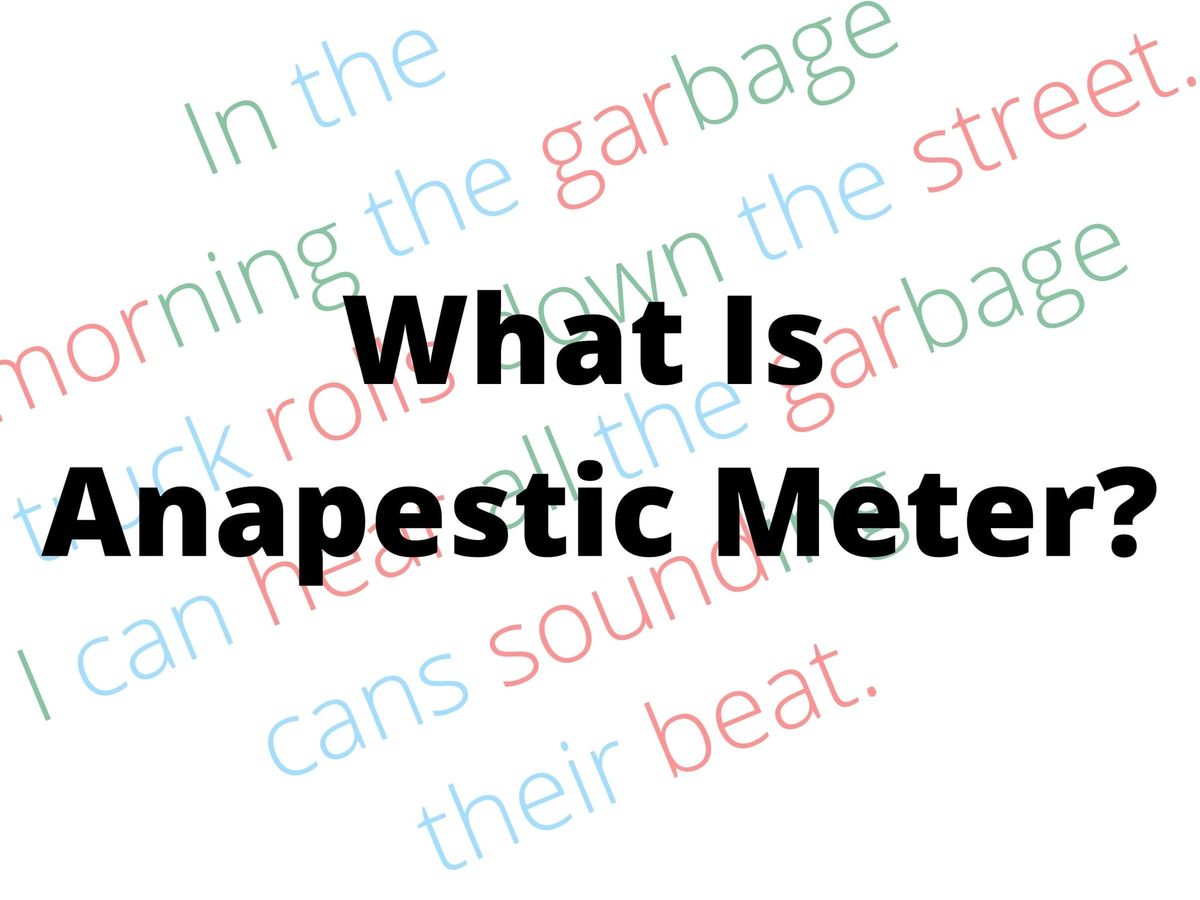
What is anapestic meter?
Anapestic meter is style of poetic verse in which every third beat—or syllable—is stressed. Anapestic meter follows a dum-dum-DUM pattern. In anapestic meter, each metrical foot is a called an anapest.
Below is an example of verse in anapestic meter. The stressed beats appear in red, while the unstressed beats appear in green and blue.
In the morning the garbage truck rolls down the street.
I can hear all the garbage cans sounding their beat.
What is dactylic meter?
Dactylic meter is a style of poetic verse in which a metrical foot consists of one stressed beat followed by two unstressed beats. Here, each metrical foot is called a dactyl. Dactylic meter is the exact opposite of anapestic meter, which is why anapestic meter is sometimes referred to as antidactylus.
Below is an example of dactylic meter. he stressed beats appear in red, while the unstressed beats appear in green and blue.
Bear loosed a roar and looked up at the sky.
How was it fair that a bear could not fly?
In poetry, and especially in children’s books, anapestic and dactylic meter tend to get mixed together. Often a line of rhyme will begin with just single unstressed beat rather than two. Other times, a line will begin and end with a stressed beat, as in the example above, which cuts off the last two unstressed beats.
Pro Tip: In children’s books, ending on a stressed beat is typically preferable. This makes for stronger rhymes and gives more punch to the end of each line. Should you choose to end on a downbeat, ensure that the matching line does the same.
What is a stressed beat?
In rhyme, stressed beats—or upbeats—are the syllables that get emphasized when reading. Unstressed beats—or downbeats—are the syllables that fall to the back and receive less emphasis when reading.
All words contain natural stresses. When writing in rhyme, it is important to understand where those natural stresses fall in a word and to ensure that the naturally stressed syllables of the word align with the location of the stressed beats in a line of meter. This is particularly important when writing in anapestic meter, to ensure that the naturally stressed beat on a word is not falling in the position of one of the downbeats.
To determine which syllable in a word is stressed, consider looking up the word in the dictionary. The syllable with the ‘ symbol before it is the stressed beat.
Try saying the words fascinate, aquarium, and inopportune aloud. Listen for where you naturally stress the word.
Then take a look at the stressed beats below.

In the word fascinate, the stress falls on the first syllable. No other stresses appear in the word. This means that when writing this word in anapestic meter, the next syllable after the word would need to be stressed.
It will fascinate yearlings to see the wind blow.
In the word aquarium, the stress falls on the second syllable. This means that in anapestic meter, the last syllable before the word aquarium would also need to be unstressed, while the first syllable following the word must be stressed.
But inside the aquarium, fish swam around.
In the word inopportune, the stress falls on the fourth syllable. But there is a secondary stress on the first syllable, as noted by the (,) circled in blue. This is the perfect example of a word that is naturally an anapestic word.
At an inopportune time, the zebra got loose.
Remember, different accents can lead to different pronunciations, and therefore different stressed beats. When in doubt, always check a word in the dictionary to confirm where the stressed beat truly falls.
What is anapestic trimeter?
Anapestic trimeter is a line of poetry written with three anapests, or metrical feet. Anapestic trimeter typically contains 9 syllables per line.
Below is an example of anapestic trimeter.
As I gazed at the deepest blue sea,
I could not guess what might come to be.
It was time for the guests to arrive,
But it seemed we had four and not five.
What is anapestic tetrameter?
Anapestic tetrameter is a line of poetry written with four metrical feet. This is one of the most common types of rhyme in children’s picture books, and can be found in stories such as The Cat in the Hat and Room on the Broom. Anapestic tetrameter typically contains 12 syllables per line, though it is possible to contain ten syllables if the line begins on a stressed beat.
Below is an example of anapestic tetrameter from ’Twas the Night Before Christmas:
‘Twas the night before Christmas, and all through the house,
Not a creature was stirring, not even a mouse.
The stockings were hung by the fire with care,
In hopes that St. Nicholas soon would be there.
What is anapestic heptameter?
Anapestic heptameter is a line of poetry written with seven metrical feet. Anapestic heptameter is another common meter in children’s picture books, and is often broken across two lines, one with four feet and one with three feet.
Below is an example of anapestic heptameter:
One morning I set out to go to the farm,
Where I planned to buy eggs and some cheese.
But when I arrived I was spotted by geese
And I instantly started to sneeze!
 Related articleWhat Is Iambic Meter: Stressed Syllables within IambsA guide to the different types of iambic meter, including iambic tetrameter and iambic pentameter, including how to find stressed syllables in a word.Read the article →
 Related articleHow To Write a Rhyming Children's Book in Perfect Rhyme!Rhyming children's books, whether in iambic meter or anapestic meter, are hard to master. Learn how to write a rhyming picture book in perfect rhyme.Read the article →