Show, Don't Tell—A Guide to Stronger Writing, with Examples

Contents
What does Show, Don't Tell mean?
"Show, Don't Tell" is an immersive method of writing in which characters and story are related using sensory details and actions. The point of “showing” is to pull the reader into a story by engaging all five of their senses. Showing allows a reader to feel like they are in the moment, and in the room with the characters, rather than simply a bystander observing the story from a distance.
Show, Don't Tell example:
Tell:
James stormed out of the room.
Show:
“That’s it!” James shouted.
Standing, he shoved his chair in, its legs scraping against the yellowed linoleum flooring with a shriek that made me wince. Behind me, the door slammed, a splinter of wood falling to the ground from the impact.
Pro Tip: how much more detailed the show example is. From this, we understand that James was angry and stormed out. But we also get a sense of setting: yellowed linoleum tells us this is an old room, most likely a kitchen. The scraping of the chair is a visceral sound that we can almost hear, and we can imagine how hard the door must have been slammed to make the door frame break.
Showing also allows a reader to read into the book, to infer information about a character. For example:
Show, Don't Tell example:
Tell:
She had been crying.
Show:
Her eyes were puffy, and red-rimmed. Dried streaks ran down her face, leaving discolored patches on her makeup.
Here, we don’t need to be told directly that the girl was crying. By showing us how she looks, we can infer that the girl has been crying. The same can be done through actions. We don’t need to be told a character is cold. We can see them shiver, see them pull their jacket tighter, or see them rub their hands for warmth. All three are more interesting and engaging than simply saying, “He was cold.”
Why does Show, Don’t Tell matter?
Telling is boring. It’s straightforward and does nothing but give us the facts. There is no emotion behind it.
Showing, on the other hand, makes a reader feel what is going on. It gives the reader a sense of character and of setting. It is compelling. And that makes a reader want to keep turning the page.
Showing is also a great way to further character development. Instead of simply telling us how a character acts, we can see—and infer—from their actions. Look again at the example from above:
“That’s it!” James shouted.
Standing, he shoved his chair in, its legs scraping against the yellowed linoleum flooring with a shriek that made me wince. Behind me, the door slammed, a splinter of wood falling to the ground from the impact.
At no point do we need to be told that James is angry. We get it from the context of the scene and from his actions.
All of this matters because, as writers, we want readers to care about our characters. We want them to be invested in our stories. And that starts with pulling a reader in and letting them get to know our characters as intimately as possible.
5 Show, Don't Tell tips with examples
Of course, it’s easy to say “Show, Don’t Tell,” but how as a writer can you actually do that?
Use internal thoughts
One of the best ways to show rather than tell is to get us into a character’s head. Let the reader see what they are thinking and how they feel about a situation at the rawest emotional level, rather than just leaving it at “She was sad.”
Show, Don't Tell example:
Tell:
Alice cried as she watched her mother leave.
Show:
Alice sunk to the ground. How? How could she just . . . leave? The tears streamed down her face, but she hardly noticed them. Her eyes were focused on the door . . . waiting. Please. Please. Just open.
Use dialogue
In the same way that internal thoughts let a reader get into the protagonist’s head, dialogue allows a reader to understand what the other characters are thinking. Use your dialogue to show a character’s emotions. While using “said” is often the best option when it comes to dialogue tags, there is a time and a place for louder dialogue tags, often when you need to show a particularly emotional scene.
Show, Don't Tell example
Tell:
She laughed.
Show:
“And then he went—he went—” Maria shook her head, her laughter so hard she couldn’t get the words out. Holding up a hand, she tried to catch her breath. “He went head over heels over the chair!” she howled, clutching her sides.
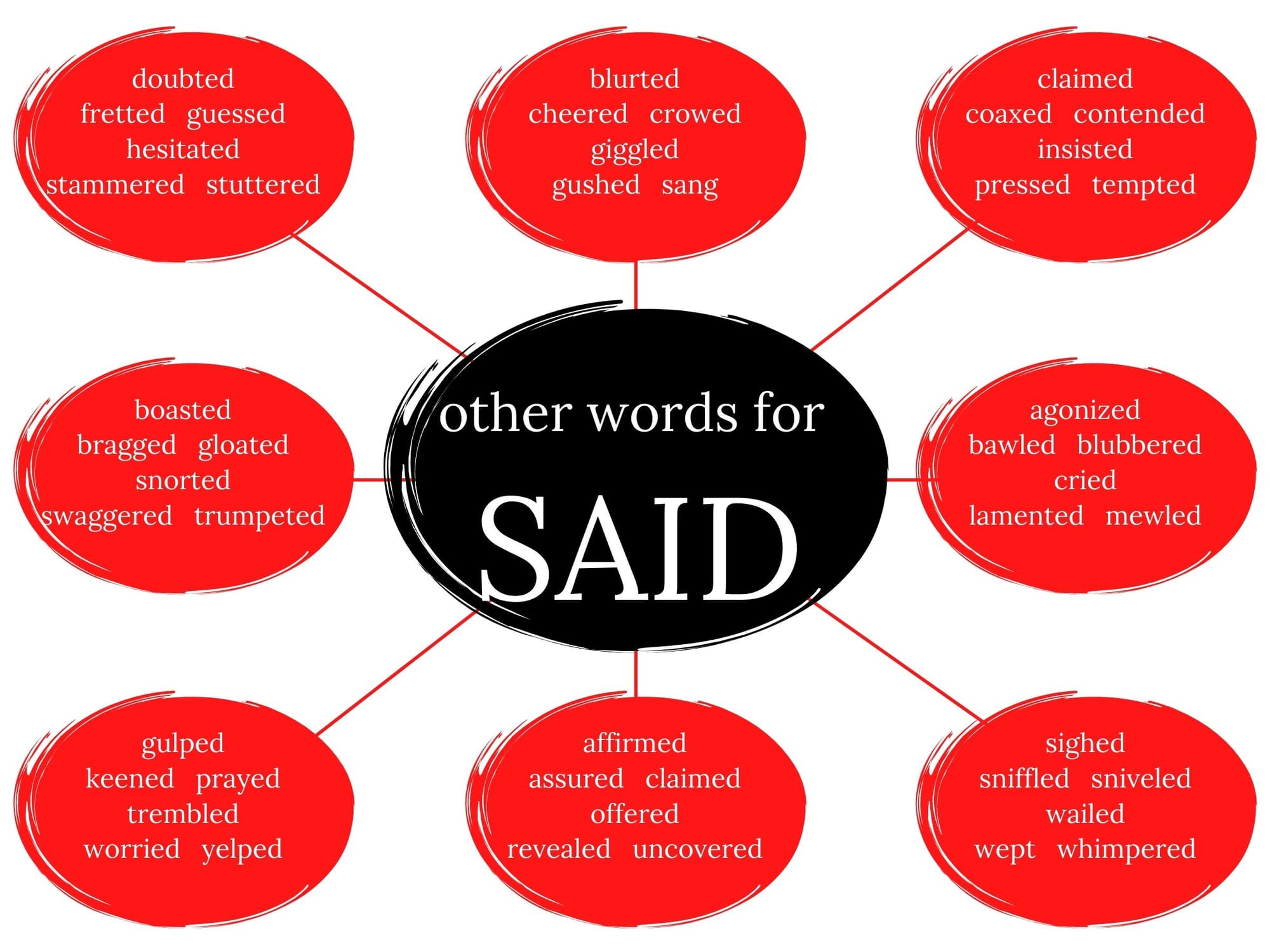 Related article335 Alternatives to Said to Spice up Your DialogueWriting a novel or short story? Spice up your dialogue with these 335 alternatives to “said” and “asked.” Broken up by emotion for easy searching!Read the article →
Use strong verbs
Remember that the simplest verbs are also the most boring. So use stronger words. Did a character walk, or did they stomp, storm, or prance? Did they cry, or did they whimper, sob, or howl?
Create a sense of setting
In a picture book, art tells the story as much as the text. But in a longer novel, the author has to paint the picture.
Show, Don't Tell examples:
Tell:
The walls were cream.
Show:
The walls were painted eggshell, with cracks running down them that made it apparent no one had thought about this room in ages. On the ceiling, a water spot seemed to grow with every minute.
Tell:
Something was burning. I tried to open the window, but it was stuck.
Show:
Smoke poured from the oven, and the acrid scent of burnt meatloaf filled my nostrils. I tried to open the window, but years of caked on paint had made it impossible to budge.
In both cases, we get a stronger sense of scene. The cracks in the walls and the caked on paint on the window both tell us that this is a run-down setting, not someone’s warm cozy home.
Include sensory details
The point of showing is to draw the reader in—to make them feel like they are a part of the scene, not an outside observer. And being part of a scene means employing our five senses, so give the reader something to grasp onto.
Show, Don't Tell example:
Tell:
The room smelled funny.
Show:
The room smelled of spices. Cardamom and saffron and paprika, and something I couldn’t quite put my finger on.
By digging deeper into the specifics, the reader is invited to use their senses to visualize the room, making for a more immersive and emotional reaction to the scene.
When is it okay to tell?
Not every word in a book needs to utilize show, don’t tell. There are times when, as an author, you want to get through something quickly. Moments that progress the plot, but aren’t pivotal to the story. If they aren’t emotionally charged moments, or if the setting doesn’t matter, then by all means, tell the reader what’s happening.
Tell example:
Suzy grabbed her keys and ran out the door. If she didn’t get to work on time, she was going to be late.
Here, we don’t need to see what Suzy’s keys feel like or what the room she’s in looks like. The point is that she’s in a rush, and that’s enough.
Tell example:
John hurried through security and down to the boarding gate. Showing his ticket, he made his way down the jet bridge to his seat.
Again, the fact that he’s boarding a plane isn’t necessarily important. Where he’s going probably is, but the specific details of getting onto the plane can be glossed over. We don’t need to know what color the walls are or what the plane smells like, unless that invokes some bigger memory or thought.
Remember, when it comes to writing, there is always a place for telling. But if you want to keep a reader interested, Show, Don’t Tell. Draw your reader in and then hold their attention by immersing them in the world you’ve created as thoroughly as possible. Your book and your storytelling will be that much richer for it.