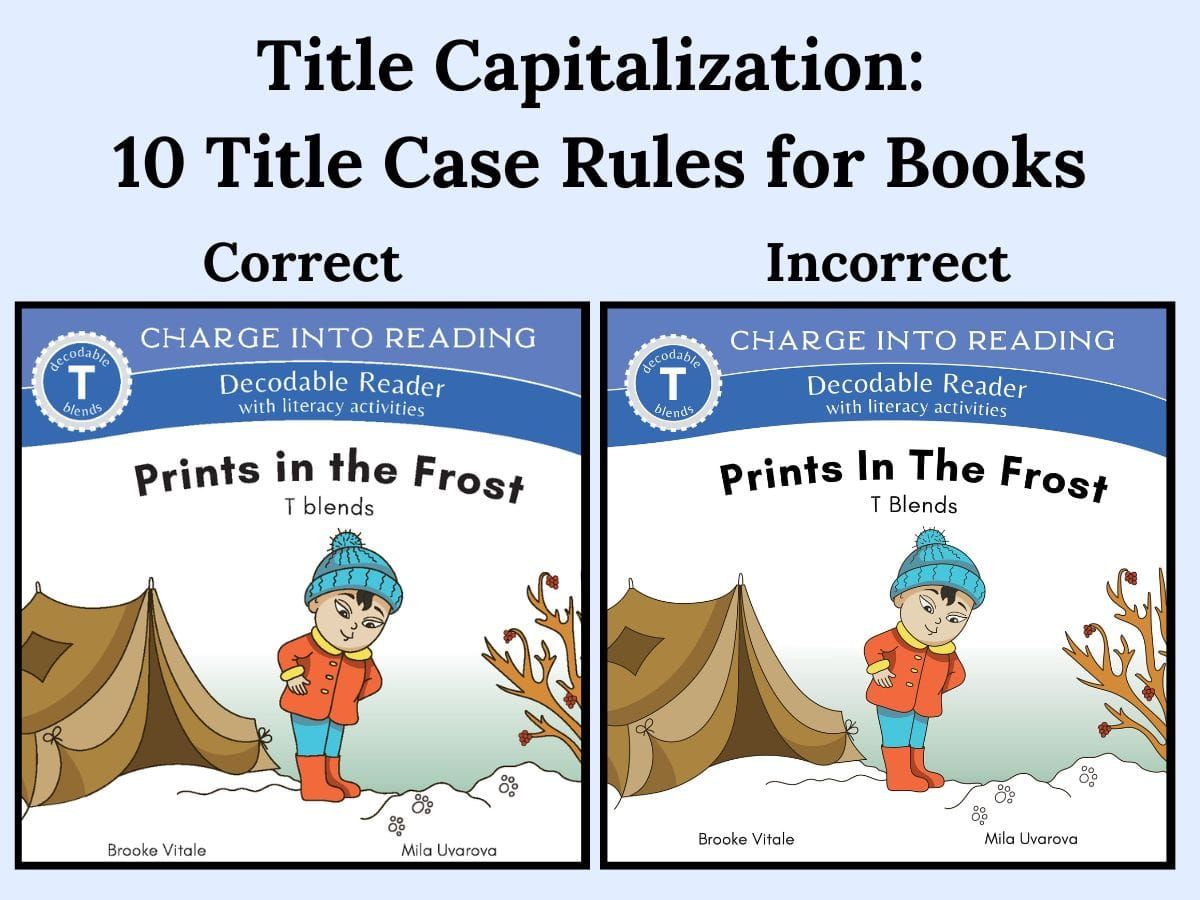
Title Capitalization: 10 Title Case Rules for Books
Contents
Titles. Every book has one, and picking the perfect one can be hard. But sometimes the real mystery isn’t how to pick a title, it’s how to capitalize a title. The rules of book title capitalization, also known as title case, can vary based on the style guide you’re using. And that can lead to an awful lot of confusion. But there’s good news. Most books follow the Chicago Manual of Style, which is very specific on which words to capitalize and which words not to capitalize. So let’s take a deeper dive to make sure that your book title is perfect. And remember, title case goes beyond just the title of your book. Title capitalization also applies to subtitles, chapter titles, blog headings, and more!
What is title case?
Title case is a set of rules writers should follow in order to properly capitalize words in titles. This applies to everything from book titles to email headings. Title case, also known as headline case, is a literary principle that divides title words into major or minor categories based on their parts of speech. Major words are almost always capitalized, while minor words frequently remain uncapitalized.
Major words include first and last words, nouns, pronouns, verbs, adverbs, and adjectives
Minor words include conjunctions, articles, and short prepositions
A general understanding of the parts of speech is especially important in identifying the major and minor words in a title.
 Related articleHow to Format Dialogue in a Story: 10 Dialogue Rules to FollowFrom where to put punctuation in dialogue to when to open and close quotation marks, learn all you need to know about properly formatting dialogue in a story.Read the article →
How do parts of speech impact title capitalization?
Knowing what words are or aren’t capitalized in a title largely depends on the writer’s understanding of the parts of speech, which is how a word is classified in a sentence based on its function.
The eight parts of speech are: noun, pronoun, verb, adverb, adjective, article, preposition, and conjunction.
The chart below breaks down each category, explains its function, offers examples, and tells you whether you should or shouldn’t capitalize it in a title.
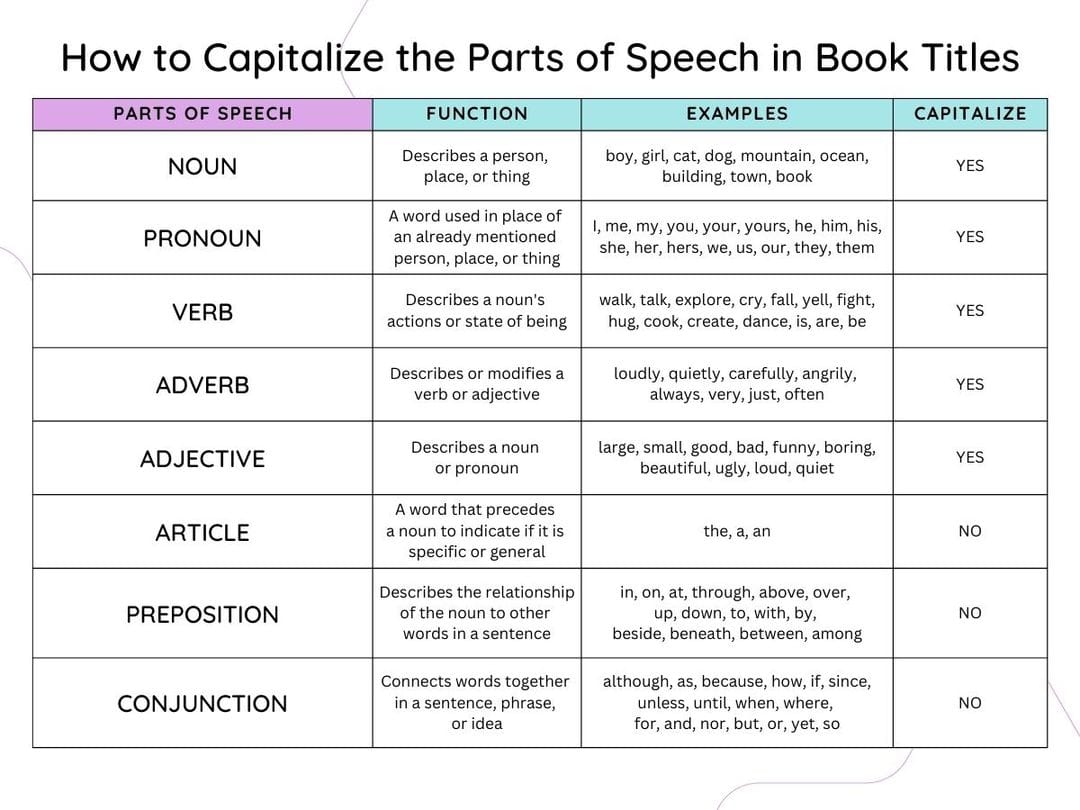
Pro Tip: Not sure what part of speech a word is? Head over to your dictionary and check it out. All definitions will include a part of speech.
Another common part of speech not included here is an interjection, which expresses a strong emotion (Wow!). These typically stand alone, and are not grouped with other parts of a sentence. As such, they are frequently the first (or only) word in a title. In such a case, they should be capitalized.
What to capitalize in titles
Title case has long been a topic of discussion, primarily because it doesn’t follow the same grammatical rules used in basic sentence structure. Different writers use different style guides depending on their field of work. For example, journalists tend to follow AP style; MLA and APA styles are more geared toward scholarly writing; and book publishing tends to lean more toward The Chicago Manual of Style. Since we’re talking about book titles, let’s take a look at the rules according to The Chicago Manual of Style.
Pro Tip: While small rules may change across different styles guides, the rules below generally remain consistent regardless of style choice.
 Related articleProofreading Marks: What Are They and Why Do They Matter?A comprehensive guide to what standard proofreading marks look like, how to use proofreading marks, & the benefit of reading on paper versus digitally.Read the article →
First and last word
When it comes to book titles, the first and last words of a title are always capitalized. This is true regardless of what the words are or their specific parts of speech.
Wrong: Where the Wild Things are
Correct: Where the Wild Things Are
Note the capitalization here of the word about. Although about is a preposition, it must be capitalized as the first word in the title.
Nouns and pronouns
In title case, you should always capitalize nouns and pronouns. Nouns refer to a specific person, place, or thing. Pronouns are used to replace an aforementioned noun.
Wrong: If you Give a Mouse a Cookie
Correct: If You Give a Mouse a Cookie
Pro Tip: The word “my” is a possessive pronoun and should always be capitalized. “It” also acts as both a noun and a pronoun and should always be capitalized.
Verbs
Considered major words in title case, verbs should always be capitalized.
Wrong: This is Where We Live
Correct: This Is Where We Live
Pro Tip: Among the toughest words for authors to figure out title capitalization of are the words be and is. The word be is a verb and should be capitalized. All forms of the word be should also be capitalized. These include: was, were, been, being, am, are, is
Adverbs and adjectives
According to most major style guides, adverbs and adjectives should always be capitalized.
Wrong: The very Hungry Caterpillar
Correct: The Very Hungry Caterpillar
Capitalize “that”
This is a strange one, it’s true. The word that can be a pronoun, a preposition, or an adjective. Because it serves so many functions, the general rule of thumb is simply to capitalize it, regardless of where it falls in a title.
Wrong: The Little Engine that Could
Correct: The Little Engine That Could
 Related articleWriting Tips: 30 Ways to Become a Stronger StorytellerA comprehensive list of tips authors can use to become stronger writers, from idea generation to moving on from a rough draft to final touches.Read the article →
Hyphenated words
Hyphenated words can get confusing. Which part do you capitalize? The first? The second? Neither? Both? According to the Chicago Manual of Style, the first word in a hyphenated compound should ALWAYS be capitalized. The second word should also be capitalized unless it is an article, preposition, or conjunction (more on that later).
Wrong: Harry Potter and the Half-blood Prince
Correct: Harry Potter and the Half-Blood Prince
What shouldn’t be capitalized in titles
Now that you have an idea of the words in a title that are always capitalized, let’s take a closer look at the words that typically aren’t capitalized. These are considered minor words and are conjunctions, articles, and some prepositions.
Conjunctions
In almost all cases, there’s no need to capitalize a conjunction. An easy tip for remembering a short list of conjunctions is the acronym “fanboys,” which stands for: for, and, nor, but, or, yet, so.
Wrong: Pete the Cat And His Magic Sunglasses
Correct: Pete the Cat and His Magic Sunglasses
Articles
Articles should never be capitalized unless they are the first or last word of the title. The most common articles used in titles are: the, a, an.
Wrong: Harold And The Purple Crayon
Correct: Harold and the Purple Crayon
Prepositions
Prepositions are a bit iffy. So, you might need to refer to the specific style guide used in your field of writing. Several style guides say that prepositions of three letters or fewer should be lowercase, but that longer prepositions should be capitalized. The Chicago Manual of Style disagrees, stating that all prepositions, regardless of length, should be lowercase.
Wrong: The Wind In the Willows
Correct: The Wind in the Willows
The second part of scientific names
This is an interesting one because it defies the rules above. In the case of scientific names, the first word should always be capitalized, but the second should remain lower case EVEN IF it is the last word in a title or subtitle.
Wrong: Tyrannosaurus Rex: A Pop-up Guide to Anatomy Correct: Tyrannosaurs rex: A Pop-up Guide to Anatomy
For more information on this particular rule, check out the Chicago Manual of Style article here.