Pen Name Generator: Tips and Tricks to Choose a Pen Name
Contents
What’s in a name? As writers, we know our name means everything to our author brand—it’s what readers see plastered across publicity and marketing campaigns and, of course, on our book covers. But, if a writer’s name is so important, why would an author ever choose to write under a pen name?
The truth is, there are many reasons why an author might want to keep their identity a secret. And writing under a pen name isn’t as uncommon as it might seem. Some of the most famous authors out there are using either an altered version of their own name or one that is entirely made up. Just take a look at J.K. Rowling and Dr. Seuss, to name a few. If you’ve ever thought about using a nom de plume (the French way of saying pen name), then you’ve come to the right place! But before we dive into tips and tricks for choosing a pseudonym, let’s take a look at what a pen name is and why you might want to use one.
What is a pen name?
A pen name is a pseudonym—or a fake name—that a writer uses to protect or disguise their true identity. Instead of using their legal name, an author will publish their book using the fake name they have come up with for themselves. The pseudonym is the name that readers will see on book covers. It is the name the author will build a brand around, so it’s especially important for writers to keep in mind marketability when choosing a pen name.
Why do authors use pen names?
Gaining acceptance
There are many reasons an author might choose to use a pen name. The most common reason a writer might use a pen name is to disguise their identity. In fact, history is full of female writers, such as the Brontë sisters—Charlotte, Emily, and Anne—who used pen names to disguise their identity in order to increase the likelihood of their work being read. England in the mid-1800s didn’t look fondly on women doing much more than keeping house. The Brontë sisters assumed the male pseudonyms Currer, Ellis, and Acton Bell, respectively, so that their work would be taken seriously. Mary Ann Evans, whom you probably know as George Eliot, also decided to publish under an alias so that her work would be taken seriously in a male-dominated society.
Even today, female authors still hit roadblocks when it comes to reaching male readers. Joanne Rowling, better known as J.K. Rowling, was persuaded to publish her famed Harry Potter series under a more gender-neutralized pen name because publishers were concerned the book’s target audience—young male readers—would not be interested in reading a book written by a woman.
Protecting an author’s privacy
Many writers also use a pen name purely for privacy. Charles Lutwidge Dodgson, better known as Lewis Carroll (Alice’s Adventures in Wonderland), chose a pseudonym to protect his privacy. As a known scholar at Oxford, he was very careful to keep his public and private lives separate. Dodgson even went so far as to sometimes reject any mail delivered under his pen name.
Increased marketability
Marketability and branding may also impact an author’s decision to publish under a pen name. Back in the 1970s, publishers believed authors should not publish more than one book a year. The publishers feared oversaturation—that readers would tire of an author if too many books came out at once. Stephen King, being the prolific writer he is, felt the pinch of this restraint and decided to publish a series of novels under the pen name Richard Bachman. For King, the choice was more than just a way to release more books, it was an experiment—a test—of sorts. Would Richard Bachman have the same success as the newly-established thriller author Stephen King? From a personal standpoint, King used the re-brand as a way to answer whether or not his talent was the real deal. King even admits poorly marketing his Bachman collection, but one of his last novels, The Long Walk, still managed to gather a cult following before King decided to retire his pen name altogether, after his anonymity was blown.
Writing across genres
Another common reason why authors publish under a pen name is to write across genres. Agatha Christie famously did this, assuming the name Mary Westmacott, to publish six romance novels so that fans of her acclaimed detective series would not be confused. Rowling, quite the connoisseur of pen names, did something similar when she decided to publish her collection of crime novels under the pseudonym Robert Galbraith, in order to distance herself from her richly popular Harry Potter series.
Despite an author’s reasons for using a pen name, it’s important to point out that an author’s pseudonym is a powerful marketing tool. So, let’s talk about some simple tips that’ll help you choose a nom de plume that perfectly fits you and your book!
Tips for picking a pen name
If you’re considering using a pen name, it’s important to keep in mind how you plan to market yourself and your new pseudonym. Here’s a good list of questions to get you thinking about pen names and choosing the right one for you and your new author platform:
- Can I market this pen name?
- Does this pen name fit my writing style and genre?
- Can I create an author brand around this pen name?
- Will readers relate and remember this pen name?
- How will this pen name translate on social media?
- Is this pen name easy to spell and pronounce?
- Is this pen name original?
Once you’ve answered these questions, you’ll want to think about how well your name will work based on four important key publishing factors: genre, marketing, audience, and name availability. So, let’s take a closer look in hopes of giving you a better idea of how your pen name might affect your author brand and, ultimately, your book’s success.
How does literary genre affect a pen name
The genre a writer works in carries a surprising amount of influence when it comes to choosing a pen name. For example, would you rather read a thriller by Ali Knight or Alison Potter? In this example, author Alison Potter knew she needed to up the ante in order to stand out as a successful writer in crime fiction. Sharing a last name with famed children’s book author Beatrix Potter just wasn’t going to do her any favors writing crime, so she settled on something a little more snappy, dangerous even—Ali Knight.
Using a pen name as a marketing tool
Marketing is an important part of your book’s success, so you need to make sure your pen name translates well across all branding materials, especially social media. Be certain to check social media handles to see if your pseudonym is available, as well as website and blog domains.
Using a pen name to reach your target audience
Considering what age range your target group of readers falls into is essential when choosing a pen name. As previously mentioned, Joanne Rowling abbreviated her name and added an extra initial—the “K”—so that her books would appeal to a younger demographic of male readers who might not have been as eager to read about a boy wizard had they known it was written by a woman.
Selecting an original pen name
Is your pen name original? Choose pen names that don’t mimic or sound like another famous author’s name. For example, you might want to steer clear of a pen name like “Dr. Sue.”
Famous authors who use pen names
If you’re planning to use a pen name, you’re in good company. Here are 6 famous examples of children’s book authors who use pen names:
J.K. Rowling—Born as Joanne Rowling
Publishers believed their target audience—young boys—would not want to read her richly popular Harry Potter series if they knew the books had been written by a woman. Later in her career, Rowling also published crime novels under the pen name Robert Galbraith to distance herself from her Wizarding World fanbase.
Mark Twain—Born as Samuel Langhorne Clemens
The famed pen name originated from riverboat terminology and means two fathoms deep: mark (measure) and twain (two).
Lewis Carroll—Born as Charles Lutwidge Dodgson
As a scholar at Oxford, he valued his private life.
George Orwell—Born as Eric Arthur Blair
To separate his private and public lives for three key reasons. Orwell changed his name because he wished to avoid embarrassing his parents, wanted to distance himself from writing failures, and because he simply detested the name Eric.
Dr. Seuss—Born as Theodor Seuss Geisel
After he was fired from his college magazine for drinking, he adopted the alias as a way to escape the pivotal cultural and society movements happening during the Prohibition Era.
Lemony Snicket—Born as Daniel Handler
The pen name started out as a bit of an inside joke after Handler devised the name to request mailing materials he needed for research on another book.
Other popular authors who have used pen names include: Louisa May Alcott, Agatha Christie, Stephen King, the Brontë Sisters, Nora Roberts, James Grant (Lee Child), and Stanley Lieber (Stan Lee).
 Related articleBook Genres: 85 Genres & Subgenres of Fiction & NonfictionA book genre list with definitions, categorizations, & examples of the 33 top book genres across fiction and nonfiction, with a look at their 52 subgenres.Read the article →
Pen name generators
Choosing a pen name can be hard. Luckily, there are some helpful sites that make the process easier with user-friendly pen name generators. Just answer a few simple questions about your writing style and genre, and—presto! Here are 5 pen name generators that’ll help you create a new author brand in minutes:
- Pen Name Generator—This easy-to-use pen name generator bases your pseudonym on your preferred writing genre, while also giving you an option to customize first and last names.
- Masterpiece Generator—Easily create a pen name with this generator, which takes your real name, as well as your answers to some basic facts, in order to create your new alias.
- English Name Generator—Create a pen name in seconds with this English name generator, which spits out 10 new American names with a simple click.
- Fantasy Name Generator—Genre-based writers will get carried away with this fun fantasy name generator. Choose pseudonyms steeped in everything from pop culture to folklore.
- Alias Name Generator—Choose from hundreds of pen names, and even decide what letters you want your new first and last name to begin with.
How to legally use a pen name
If you plan to use a pen name to build your author brand, you’ll want to make sure you’re doing it legally. Simply put, it’s pretty straightforward and legal to use a pen name. For traditional authors, it usually comes down to simply notifying their agent and publisher. If self-publishing with a print-on-demand service like Amazon, it’s a matter of adding your pen name as the primary author or contributor. Usually, in both cases, an author’s real name will continue to be used on important documents, like contracts and tax forms.
To make sure you’re using your pen name correctly, follow this quick step-by-step guide::
- Choose a pen name: Make sure it fits your genre, author brand, and target audience, in addition to being great for marketability and social media platforms.
- Turn your pen name into a business: Like any small business owner, use your pen name to create a business umbrella for your writing. Most authors will select a sole proprietorship as their business model, but this is a decision you should discuss with your attorney or business advisor.
- Apply for an FBA (Fictitious Business Account): Also known as a DBA or Doing Business As, this is a good way to legally register your business name alongside your legal name.
- Begin using your pen name: Start using your pen name across all social media, marketing, and copyrighted materials, and most importantly, your book covers and writing submissions.
Pro Tip: If you’re planning to use a pen name, it’s always best to consult with your agent, publisher, attorney, and business advisor to make sure you’re following all the legal requirements for using a pseudonym.
Can I self-publish using a pen name?
Yes, you can self-publish under a pen name. Since most print-on-demand accounts must be created using your real name, all the important legal details are covered. When creating a book in KDP, if you choose to publish under a pen name, type your pseudonym into the primary author or contributor section under “Author” details. Here’s how:
- Click “Create” to start creating your book
- Select what type of book you’d like to create—eBook, paperback, hardcover, etc.
- In the “Details” section, scroll down to the “Author” tab
- Type in your pseudonym’s first and last name
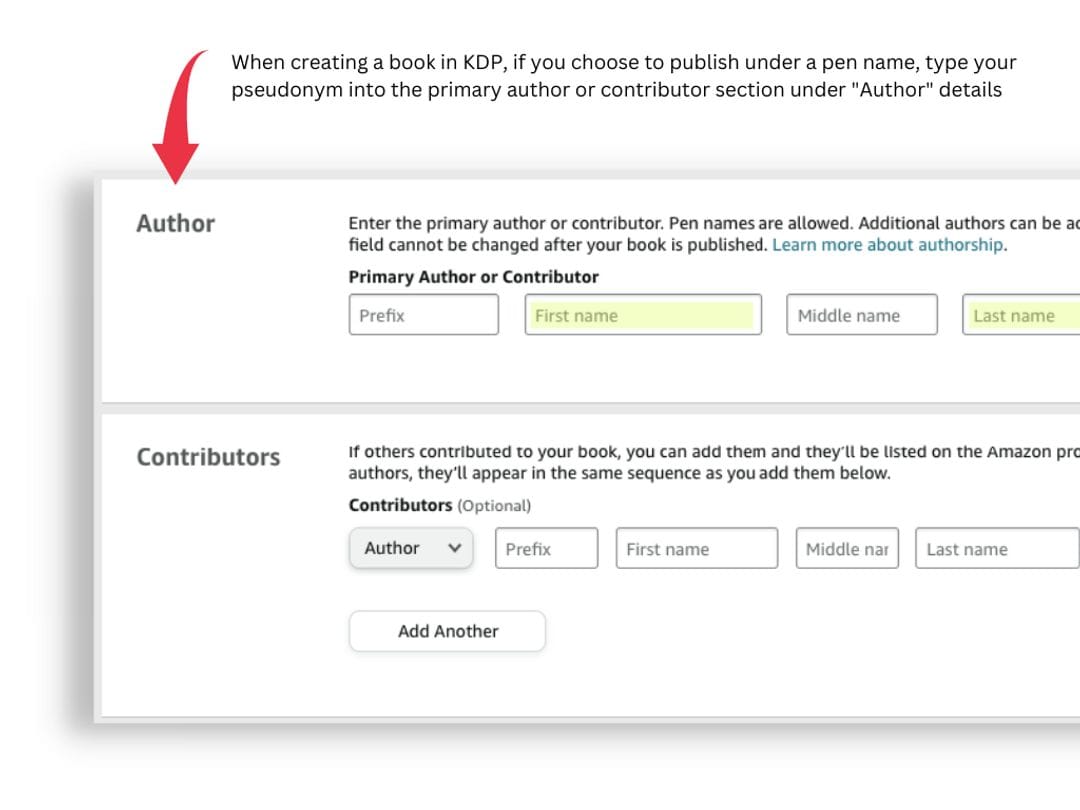
Since many authors follow a sole proprietorship business model, you can use your pen name as the primary author or contributor, instead of your real name. Once you start selling books, KDP will make payments out to your real name (the name your account is registered under) and not your pen name. Tax forms and other important documents will also be addressed to your real name. It’s important to note, though, that if you plan to use your pen name as a business, you should consult with your tax advisor or attorney to make sure all your bases are covered and you’re doing everything legally.
Should you use a pen name?
Choosing to use a pen name is entirely up to the author, whether it be for personal or marketing reasons. If you do, make sure and follow all the steps outlined above, but at the same time—have fun! This is your chance to become anyone you want to be—to become the character in your own story. Good luck!
 Related articleShow, Don't Tell—A Guide to Stronger Writing, with ExamplesA comprehensive guide to what "Show, Don't Tell" means, how to show rather than tell, and how showing can make you a better writer, and your book a better book, with show don't tell examples of what to do and what not to do.Read the article →