What Is Proofreading: the Most Misunderstood Editing Service
Contents
What is proofreading?
Proofreading is a review of designed book pages against a copy edited manuscript. A proofreader is looking primarily for formatting issues, but will also read for spelling and grammar mistakes. Proofreading is the last editorial step before a book goes to the printer (and in some cases, will even be a check against printers’ proofs, hence proofreading).
When it comes to editorial services, proofreading is hands down the most misunderstood, and an internet search proves that. In looking up "what is proofreading", the only accurate definition in the first five results was from Wikipedia. So lets talk about what proofreading is and is not. Proofreading does not come early on in the editing process. It is not a look at character development or a check for typos or story consistency. Those steps belong to developmental editing and copy editing. It is not a confirmation that anything stated in the book is accurate. That is the job of a fact checker.
What does a proofreader check for?
So if proofreaders aren’t checking for story consistency, what are they looking for? A lot! Let’s take a deep dive into what a proofreader is checking for!
Widows, orphans, and runts
The biggest part of a proofreader’s job is to confirm that a page LOOKS right. And a big part of that is ensuring that here are no widows or orphans in the text of the book.
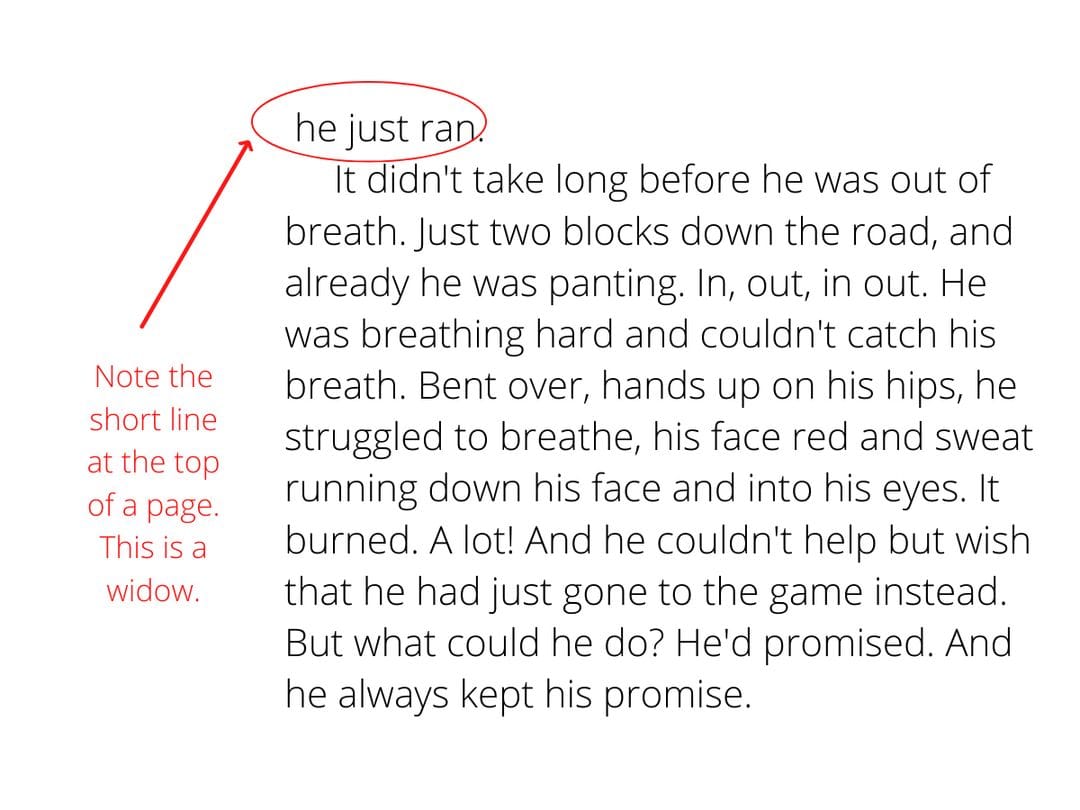
Widows are lines that run short at the top of a new page. Traditionally speaking, a line needs to run at least 3/4 of the way across the page. Ideally, the last line of a paragraph should never run by itself at the top of a new page.
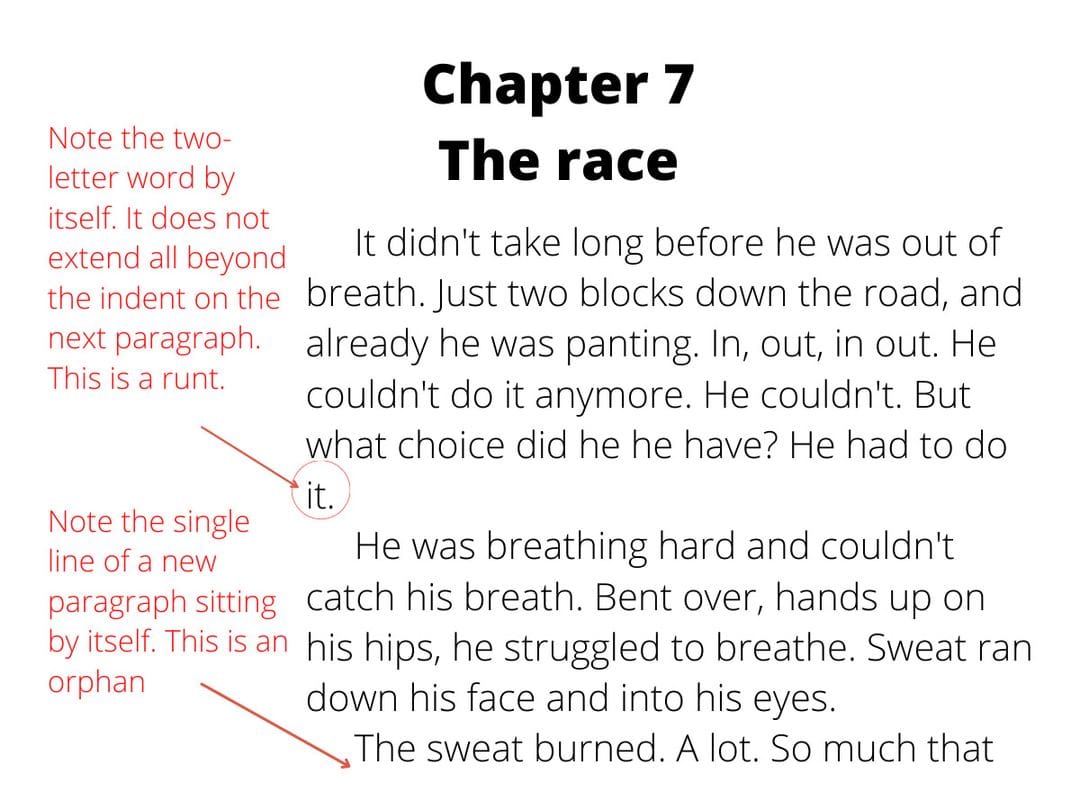
Runts are short words that fall on a line by themselves at the end of a paragraph. Traditionally speaking, it is best to avoid words (or parts of words, in the case of word breaks) less than 4 characters on a line by themselves. However, because formatting changes from book to book, the better rule of thumb is that the last line of a paragraph should extend beyond the indentation of the paragraph below.
Orphans are a single line of a new paragraph that fall at the bottom of a page. Traditionally speaking, it is best to either start a new paragraph on a new page, or ensure that there is enough space to fit 2 or more lines of a new paragraph on the page where it begins.
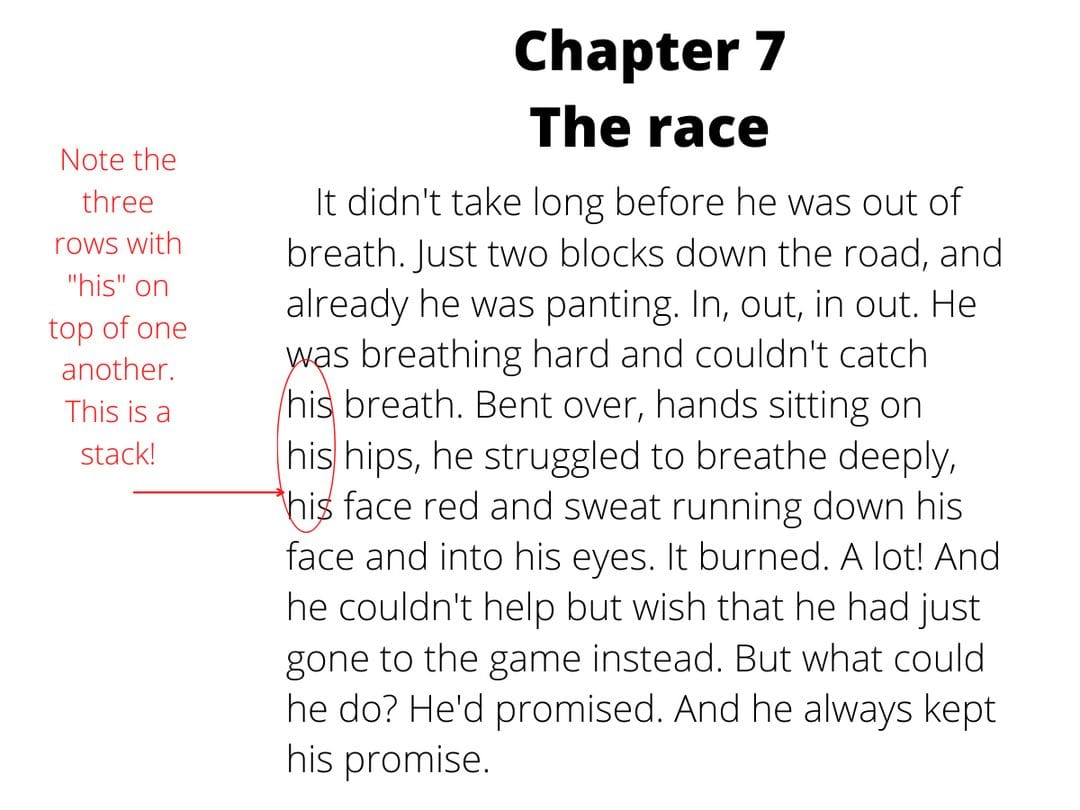
A proofreader is also looking for word stacks, places where the same word appears 3 or more times in a row, stacked on top of itself.
Page numbers
Proofreaders are checking every page of a book to ensure that page numbers are where they need to be (and not where they shouldn’t be).
For picture books, that may mean ensuring there are no page numbers.
For children’s books with illustrations, that will mean ensuring that there are no page numbers sitting over art.
And for any book that consistently uses page numbers, it will mean checking not only that they are there, but that they are all there, and in the correct order. (It’s not uncommon for books to be paginated incorrectly. It is a proofreader’s job to ensure that there is no sudden jump in page numbers.)
Running heads
Chapter books and beyond often include running heads. A running head is the text at the top of the page. It will traditionally feature the author’s name, the title of the book, the chapter number, or the chapter name.
A proofreader’s job is to ensure that running heads appear as they should—that if the book begins with the author’s name on the left side (also called the verso!), that the author’s name is always on the left side. That if the right page includes the chapter title, it not only always includes the chapter title, but that the title grammatically aligns with the table of contents and chapter opener page, and that the correct chapter title is being used on every page.
Table of contents
Because the table of contents is created AFTER a book is laid out, often the proofreader will be the only person to thoroughly check it. The proofreader’s job is to check that everything in the book appears on the page the table of contents says it does. It is also the proofreader’s job to ensure that the chapter titles are written consistently from table of contents to the interior of the book.
Index
Just like a proofreader checks the table of contents to make sure everything is right, it is also a proofreader’s job to check an index, if one exists. Is everything in alphabetical order, and more importantly, are the pages listed correct? Do the words (or concepts) listed in the index actually appear on the pages the index says they do?
Bad word breaks
Words have natural breaks in them, typically where a syllable changes. A proofreader’s job is to ensure that words break in the proper place across lines. (This may mean breaking at the natural syllable break or it may mean that a hyphenated word only breaks at the hyphen, not elsewhere.) Some publishing companies even have rules about what can and cannot break. For example, one house I worked for would not allow the letters “ple,” “tle” or “ble” to break to a new line by themselves.
In the case of a picture book, a proofreader is checking to make sure that there are no word breaks. And in the case of a chapter book, a proofreader is ensuring that words don’t break across pages (from left to right) or across spreads.
Illustration placement
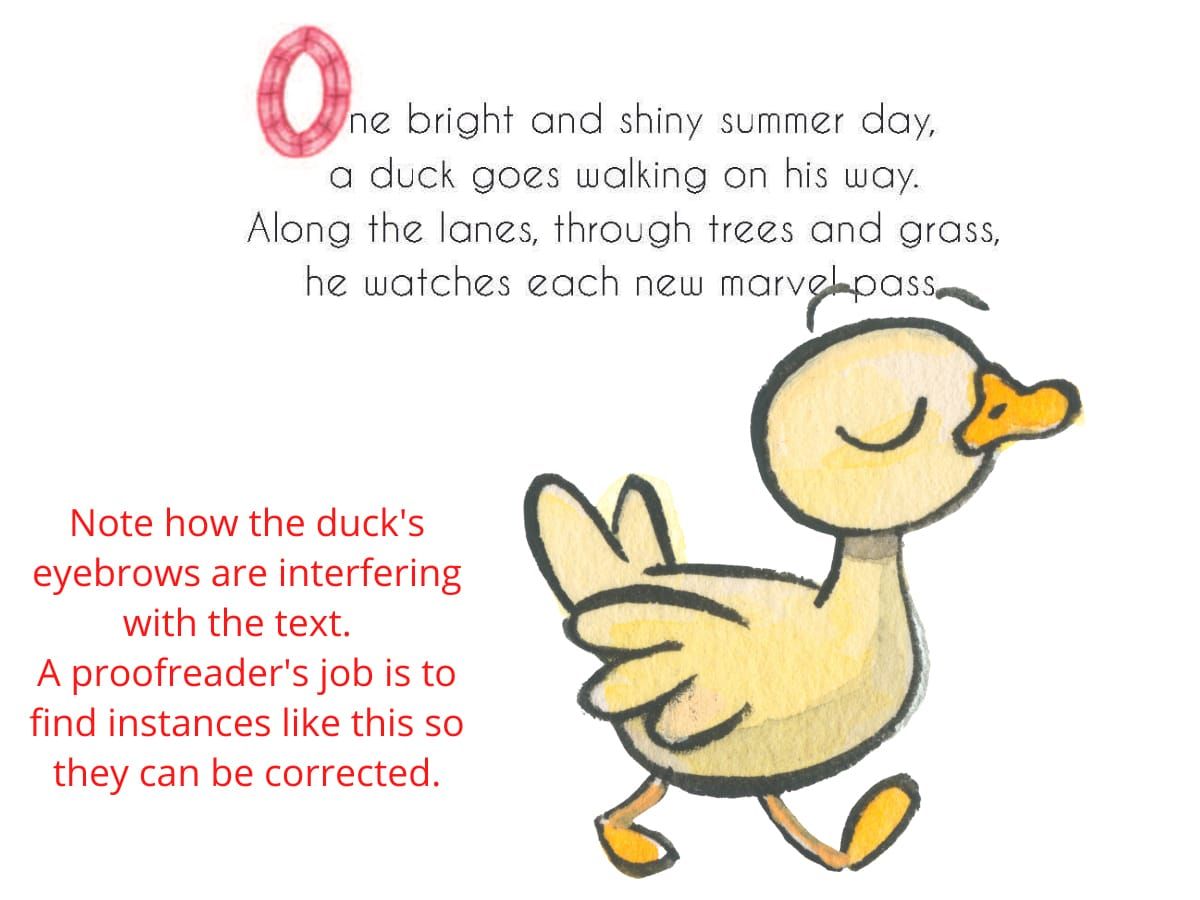
Particularly in children’s books, where illustrations are an integral part of the story, a proofreader’s job is to check art placement. Is every piece where it belongs, or did one accidentally end up on the wrong page? And equally important, is the art cutting off any text? Often a piece of art will be placed over a text box, cutting off either the very top of the text or the very bottom. A proofreader checks to make sure that’s not the case.
If the art has captions, the proofreader will also check that the correct caption has gone with the correct image.
Book layout
The proofreader’s job is also to ensure that the book layout matches the copy edited manuscript. All too often as books are laid out, errors are introduced and words are either added or cut out. A proofreader reads a book layout one word at a time, comparing it (and all the punctuation around it) to the final copy edited manuscript. This word by word reading ensures that every word matches the approved manuscript, or that it is corrected if an error has crept in.
Correcting final mistakes
No one is perfect, and no one will catch every mistake, no matter how hard they look. This is especially true in a longer book. So yes, a proofreader is checking to make sure that there are no final typos or grammar issues. But this is truly the smallest part of the job they are doing.
Tips for proofreading
I’ve lost count of how many times an author has asked me if they need to hire a proofreader, and the answer varies book by book. If the book is short (a picture book or board book) and it has been through copy editing, and if the author feels comfortable checking against the final manuscript, then no. A proofreader isn’t essential. But the author needs to be diligent and look for any tiny mistake.
For longer books, I always recommend bringing on a fresh set of eyes. (And someone different from the copy editor or editor.) Why? Because by the time an author or editor has read something several times, their eyes will gloss over mistakes. They will read what they think is there, not what is there. And a copy editor who missed something once may miss it again, so that last check should be from someone who has never seen the book.
That being said, if as an author you want to proofread on your own, here are my best tips for doing so successfully:
Read out loud
Reading out loud is hard work. Even the best reader will often stumble over words. That’s because our brains work differently when we read out loud. We have to process the words differently to form them coming out of our mouth. And in doing so, we tend to read more slowly . . . and carefully. We can’t help it. We just do. That’s why reading out loud will capture mistakes your eyes would gloss over if you read to yourself.
Read backward
This is the best trick in the book for proofreading, especially when reading against a copy edited manuscript. Instead of starting at the beginning of a book, start at the end and read the whole book backward, word by word. Why? Because it will make no sense. Your mind won’t be able to guess what’s coming next, and instead will be able to focus on finding the mistakes you missed before.
Cover your lines
If reading on paper (which is recommended for proofreading), use a piece of paper to cover the lines under the one you are reading. That will keep you focused on the words you’re reading, and will keep you from reading ahead.
Use find and replace
If you keep finding the same mistake over and over, try a find and replace. For example, mixing up its and it’s or finding that you consistently forgot to include the ’s at the end of someone’s name. A find and replace will help you to double-check all instances of that word or phrase to ensure you catch all the mistakes. (Whether you use this method or not, do run a spell check once you’ve finished the book. But look at each suggestion carefully. Don’t just accept all, because you may not agree with all of them, and the grammar issues may be a style choice, not an actual mistake.)
How much does proofreading cost?
Proofreading rates vary depending on the freelancer. For traditional publishers, a proofreader is typically paid between $18 and $23/hour.
A 2020 survey by the Editorial Freelancers Association showed that freelance proofreaders charge on average between $31 and $35/hour, with a rate of between 11 and 15 laid out pages read per hour.
Pro Tip: One important thing to keep in mind when budgeting for a proofreader is that a proofreader will typically read a manuscript twice, so make sure to double the number of hours when you figure out how long it will take to proofread your book based on your own page count.
What are proofreaders' marks?
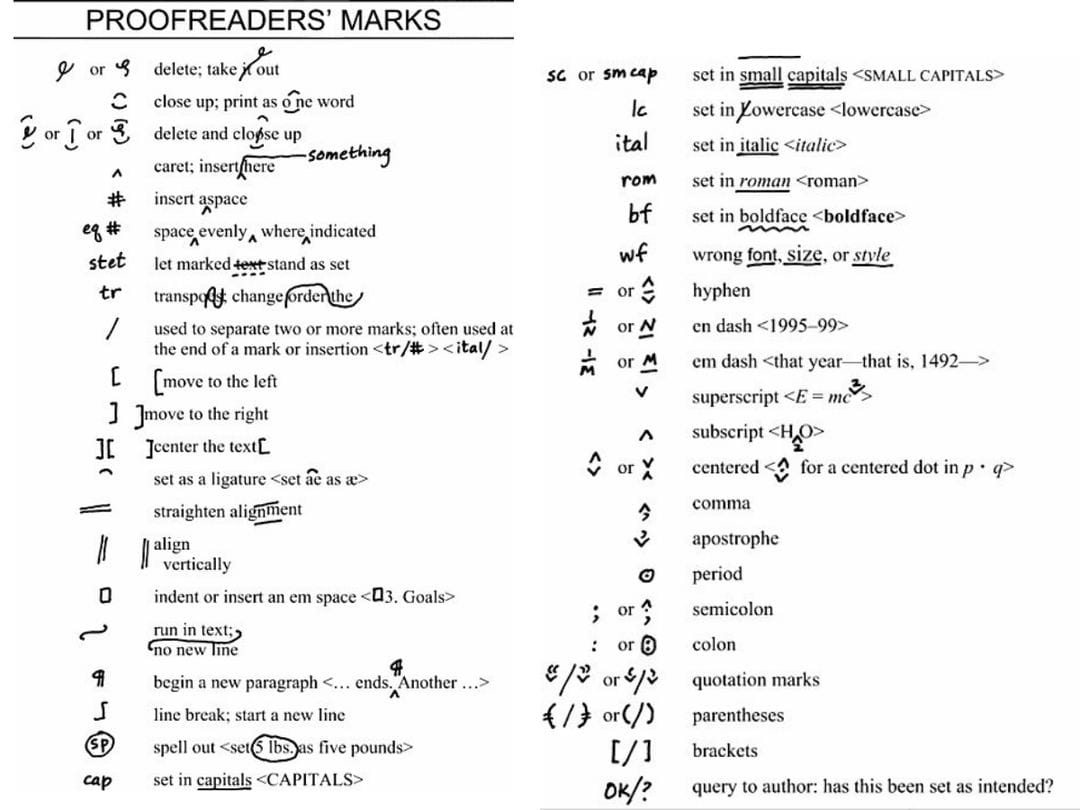
Proofreaders' marks are an established set of symbols used by all proofreaders and copy editors when editing a manuscript. Using a consistent set of marks ensures that edits are understood and will be interpreted the same by anyone who reviews the manuscript.
Years ago, when books were always proofread by hand, proofreaders had a specific way of marking up a manuscript. These were called proofreaders' marks, and everyone marked up manuscripts in the same way. By using this consistent set of marks, anyone picking up a manuscript could immediately know what needed to be changed.
These days, proofreaders mostly use tracked changes. But it’s still fun to see what the marks look like. Take a look below, courtesy of Merriam-Webster. (And yes, if you look in the physical dictionary, this is still printed inside!)
For more information about the types of book editing check out my articles: