How To Create a Book Copyright Page (with Template)
Contents
A copyright page traditionally sits at the beginning of a book and is used to identify copyright ownership, printing information, and contact information for a publisher. The copyright page of a book often also serves as a place to include a book dedication. While not mandatory, it is always recommended to include a book copyright page, as it offers readers essential information about the parties involved in creating the book. Let's take a look at a sample copyright page and how to create a copyright page. A free copyright page template is included at the end of this article to make the process of creating a book copyright page foolproof. And remember, an author's work is protected under copyright law from the moment it is written, which means that an author owns copyright on a book whether a copyright page is included or not.
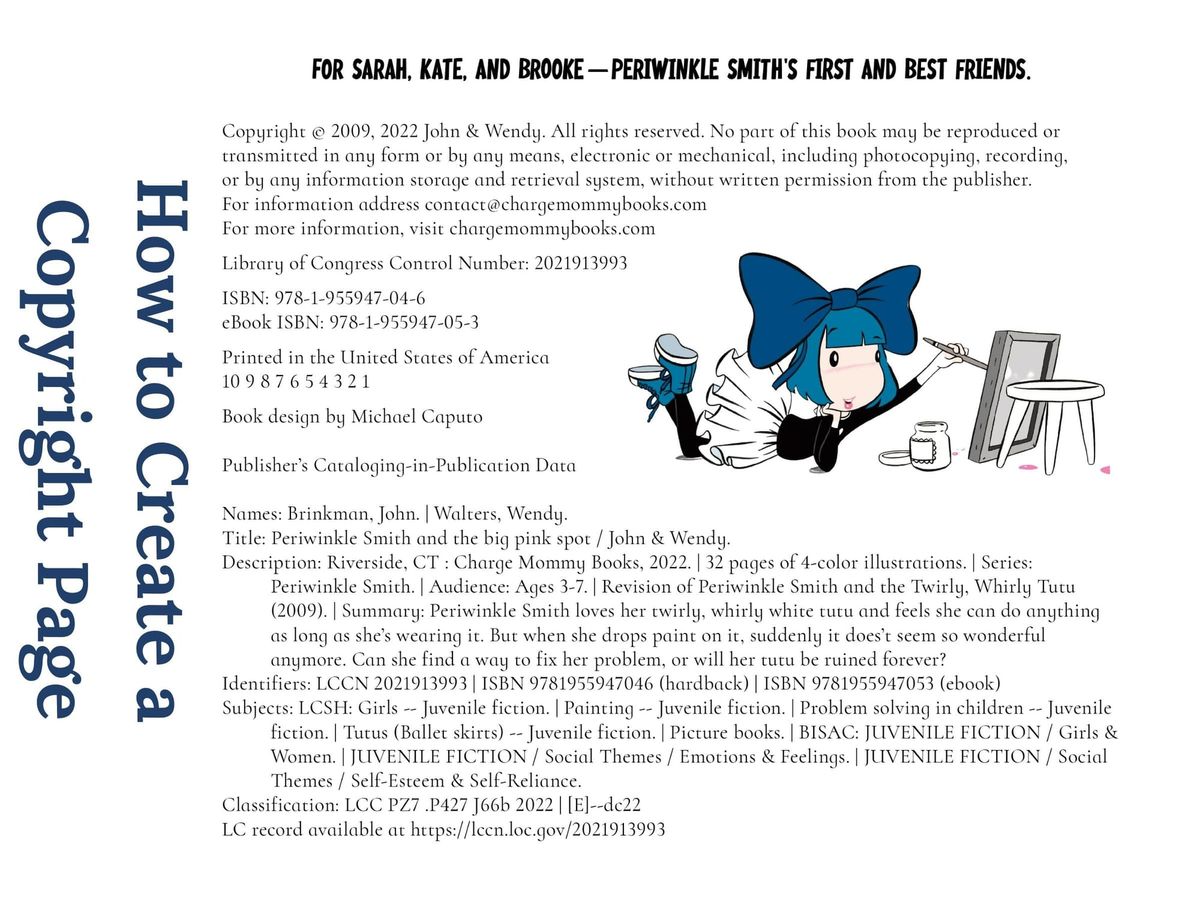
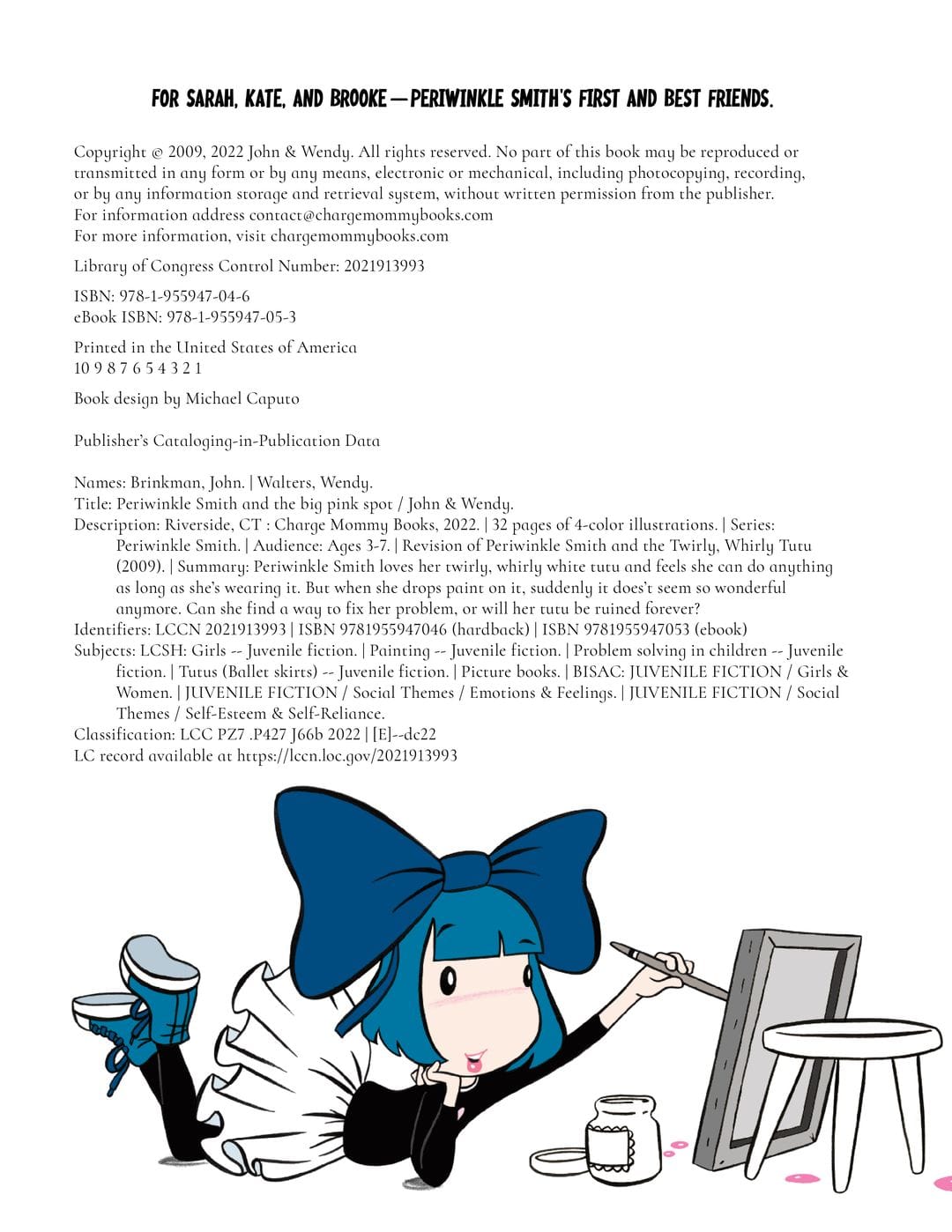
Before we go into all the elements of a copyright page, take a look at the example copyright page from Periwinkle Smith AND THE BIG PINK SPOT written and illustrated by John & Wendy and published by Charge Mommy Books.
1. Copyright notice
As the author, this is your chance to claim credit for your book and announce to the world that it belongs to you. The copyright notice consists of three parts:
- The word "Copyright" followed by the copyright symbol, ©.
- The copyright owner's name: Traditionally, the author's copyright notice is listed first, followed by the illustrator's copyright notice. Depending on the contract you signed with your illustrator, they may or may not own copyright. If copyright has been assigned to the author, it is sufficient simply to say “Copyright © 2022 [author's name]” as this encompasses text and illustrations. If copyright was assigned to your company, author copyright may be listed under your name while illustrator copyright is listed under your company name. If your contract does not assign copyright on the work to you, you must list your illustrator as the owner of copyright. Always with illustration copyright, follow the letter of your contract to ensure accuracy.
- The year of publication: This is the year the book was published—not the year the book was written. If this is a new edition of the book, two copyright years may be cited. For example: Copyright © 2017, 2021 Brooke Vitale.
A standard copyright notice looks like the following: Text copyright © 2022 Brooke Vitale. Illustrations copyright © Charge Mommy Books.
Pro Tip: Having trouble getting the copyright symbol to appear? Try typing a c inside parentheses or hitting holding down Alt while hitting "0169" on your keypad.
2. All rights reserved
The words "All rights reserved" inform anyone reading your copyright page that you and you alone have the right to reproduce the work. Simply including these words is sufficient, but if you would like to be more explicit, you may use the following language:
No part of this book may be reproduced or transmitted in any form or by any means, electronic or mechanical, including photocopying, recording, or by any information storage and retrieval system, without written permission from the publisher.
3. Contact information
Next, how do you want people to get in contact with you? This is incredibly important to include. Providing contact information allows someone to reach out to you for permission to reproduce the work in some part. It is how they know to get ahold of you if they want to buy the rights to publish the book in another country. If they can’t reach you, they can’t ask for these rights or permissions—and that may be money out of your pocket!
4. P-CIP data and LCCN
CIP (Cataloging-in-Publication) Data or a Library of Congress Control Number (LCCN) is a must for any book you want to get into a library. This is an identification number the Library of Congress assigns to each book in its catalogued collections. It is also the number libraries use to order and keep track of books. Traditional publishers file for CIP Data for each book. Unfortunately, for self-publishers, getting CIP data is not possible. But getting a P-CIP number is.
For information on how to acquire P-CIP data, check out my post What is CIP Data, P-CIP Data, And How to Get P-CIP Data.
Pro Tip: Not all book copyright pages will include CIP or P-CIP data. This may be because an author chose not to file for P-CIP data, or because the data is too long to fit on the copyright page. If you have acquired P-CIP data be sure to enter it on the copyright page exactly as it was delivered. If the language cannot fit on the page, it is acceptable to say "P-CIP Data Available."
5. ISBN
Every book has an ISBN , and it’s good to list it on a copyright page. But you don’t have to list just one. If you have multiple editions of your book (for example, a hardcover and a paperback, or one published through IngramSpark and one through KDP) it is perfectly acceptable to list all of those ISBNs on the same copyright page so that you do not need to create multiple copyright pages for each book.
With each ISBN you list, just be sure to make which edition it references clear. For example:
Hardcover ISBN
Paperback ISBN
eBook ISBN
For more information on what is an ISBN, check out my article How to Buy an ISBN, When to Buy an ISBN, and What ISBN Means.
6. Edition of the book
Listing the edition of the book tells readers whether this is the first time a book has been released, or whether it is one of several editions. This may be as simple as including the words "First Edition" or "Third Edition" or you may wish to be a bit more explicit, with language such as "First Edition: March 2022" or "First Hardcover Edition: March 2022." Picture books and novels don't tend to change, meaning that they rarely have second editions. As such, this language is entirely optional. On nonfiction that needs to be kept up-to-date, listing an edition is a good way to tell your readers the last time the information was updated.
7. Printing location
Although listing the country a book is printed in is not required, people do like to know where it was printed. If it was printed in the United States, spell out the name of the full name of the country: Printed in the United States of America.
8. Printer's key
The printer's key, also known as the number string, or the number line, indicates what print run a book is on. If you are using a book printer, this is your chance to tell the world how many times the book has been printed. With each print run, the lowest number is removed.
For example, a number string that reads “10 9 8 7 6 5 4” indicates that you are on the fourth print run.
Note: starting with the number 10 on the left assumes that your copyright page text is left-aligned. If your copyright text is centered, it should read:
1 3 5 7 9 10 8 6 4 2
This allows numbers to be removed evenly from left and right, thus keeping the text centered.
Pro Tip: The number string is not used for print on demand books, as there are no true print runs.
9. Credits
You are under no obligation to credit your book designer or book editor. However, if you would like to do so, the copyright page is the best place to include an acknowledgement.
This is also a good place to put any other credits, such as thanks to people who helped you earlier on in the book process (researchers, beta readers, friends who had a heavy hand in the book creation.)
10. Third party copyrights and permissions
If anything in your book came from a third party, this is the place to acknowledge that and give credit. Whether it is the cover photo, photos used on the interior, a snippet of another book, or a font that is owned by someone in particular, call that out and give the required credits.
11. Disclaimer
Too often, readers see themselves in a book. Particularly in a book of longer fiction, it is advised to add a disclaimer. Disclaimer language may read as follows:
This is a work of fiction. Any resemblance to actual persons, living or dead, events, or locations is coincidental. Similar types of language for a nonfiction or memoir are advised. Look to other books in your genre for the best language, as it changes by subject.
12. Dedication
Author and illustrator dedications often appear on the copyright page. They can be placed at the top or the bottom of the copyright page, or can have a page entirely of their own. Dedications are not necessary in a book, and are included at the author's discretion.
13. Download free copyright page template
The links below include free copyright page templates for your use.