Kindle Calculators: 3 Must-Have Book Publishing Calculators
Contents
What is an Amazon book sales calculator
Every book sold on Amazon comes with an Amazon BSR. This stands for Amazon Best Seller Rank. The Amazon BSR is the number Amazon uses to indicate how well a book is selling. Because there are millions of books available on Amazon, this number can be very telling. But for most people, the Amazon BSR doesn’t provide any real information. True, it will tell you if a book is popular, but that’s about all. Luckily, there is a way to find out what the BSR means in terms of actual sales: an Amazon Book Sales Calculator.
Amazon Book Sales calculators allow you to enter a books BSR and get back the number of sales this equates to both in terms of daily sales and monthly sales. Unfortunately, there are no Amazon-built book sales calculators, so there is no guarantee that the numbers returned are 100 percent accurate, but they are close. Although there are several Amazon book sales calculators available, the top two come from TCK Publishing and Kindlepreneur.
How is Amazon BSR calculated?
The Amazon BSR is an ever-changing number. It is updated every hour and takes into account not just a book’s current sales, but also a book’s sales history. Books with steady sales over a month will rank higher than those that peak for two to three days and then fall off again. Books that rank higher than 1,000 can generally be assumed to have strong, consistent sales of at least 100 units a day. This is the goal line for most authors who are self-publishing a book. As this rank goes down, so does the number of books being sold every day.
How to find an Amazon BSR?
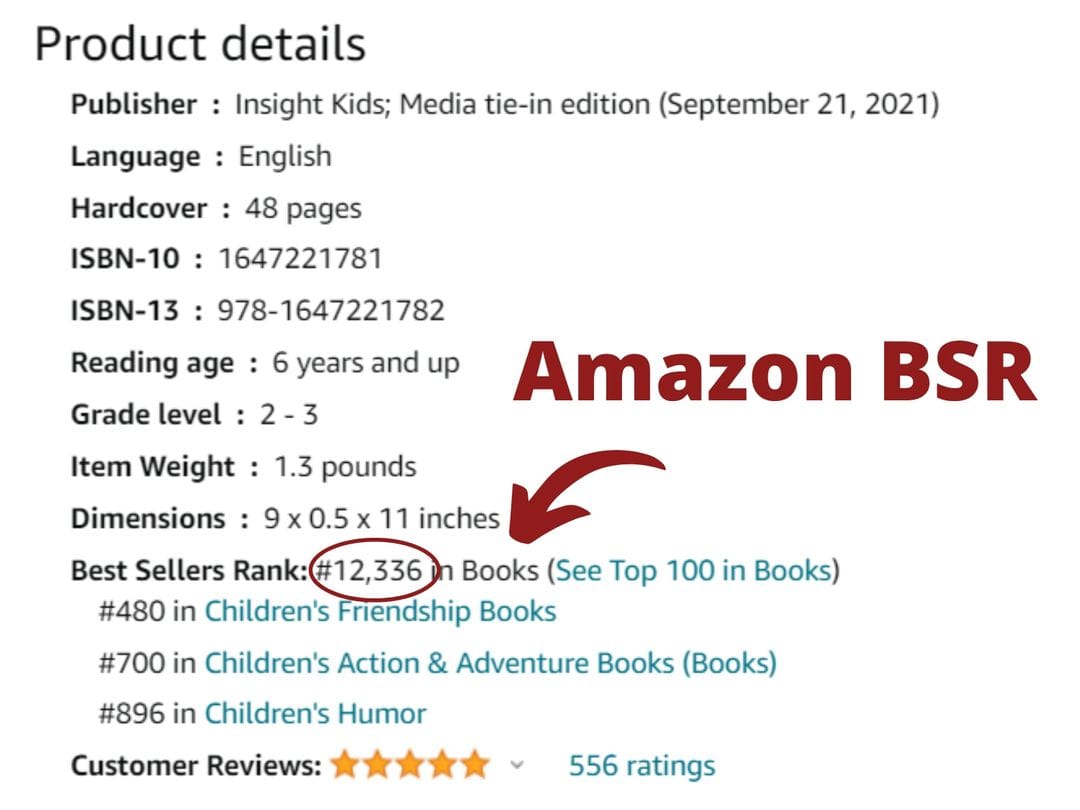
Each book sold on Amazon has a BSR. This can be found in a book’s product details, which appear beneath a book’s A+ Content and Editorial Reviews. (For more information on creating A+ Content for your book, check out Amazon A+ Content: Creation, Best Practices, and Examples. For more information on how to get Editorial reviews, visit my article, Amazon Editorial Reviews: An Author's Best Marketing Tool.)
Below is an example from Goonies: An Illustrated Classic, which I wrote for Insight Editions. At a BSR of 12,000, this book is selling roughly 20 books per day.
When looking for an Amazon BSR, keep in mind that each book format (hardcover, paperback, and or eBook) has its own BSR. eBook BSRs are broken out a bit differently, as eBooks are often included in free promotional days. When checking the BSR for an eBook, take note of whether the ranking says, “Paid in Kindle Store” or “Free in Kindle Store.” BSRs from free promotions can be misleading, as a consumer’s willingness to download something free cannot be directly equated to their willingness to pay for it.
How does Kindle Unlimited impact BSR?
While it may seem that reads through Kindle Unlimited would count as “free” reads, this is not the case. Amazon consumers who use Kindle Unlimited do not purchase eBooks. Instead, they get to “borrow” them, as if from a library. But this is not a free service. Because these users pay for access to Kindle Unlimited, their page reads count toward books sales, not free giveaways. For more information on how Kindle Unlimited works, check out my article KDP Select or Only Amazon KDP: How to Pick the Right Option.
Why does Amazon BSR matter?
As an author, it’s great to know how your own titles are performing. But the true value behind Amazon BSRs lies in understanding how other books are performing. Why? Because understanding Amazon BSR allows authors to plan select appropriate book categories, understand what is needed to reach best-seller status.
Selecting Amazon book categories with BSR
It’s no secret that Amazon provides a bigger push for books that sell well, and one way in which sales are monitored is by category. It’s not uncommon for a book buyer to type in a general search such as “bedtime book” or “duck book.” When this happens, Amazon relies on a book’s categories to deliver results, and the higher ranked a book is within that category, the higher it will appear on the page. Even better, books that perform at the top of their categories get the coveted “Best-Seller” badge that helps authors to market their books. That’s why properly categorizing a book is so important. But here’s the big secret: while it’s tempting to just pick the categories that make the most sense for the book, that may not be the best plan to achieve best-seller status.
Generic categories tend to get over-populated, making it hard for any book other than the true best-sellers to stand out. Instead, try looking at several related categories for your book. Check the BSRs on the top books in each category. It may be that getting to the top of the best-seller list will be easier in some categories than in others.
Take a look, for example, at the best-sellers list for children’s sports books about cycling. Here, the number one book is ranked 16,000. That puts it at sales of roughly 17 copies per day. In order to overtake that number one slot, one only needs sell 18 copies a day. Moving down the list, the number 10 book on this best-sellers list holds a ranking of 154,000, which means it sells roughly 2 books a day.
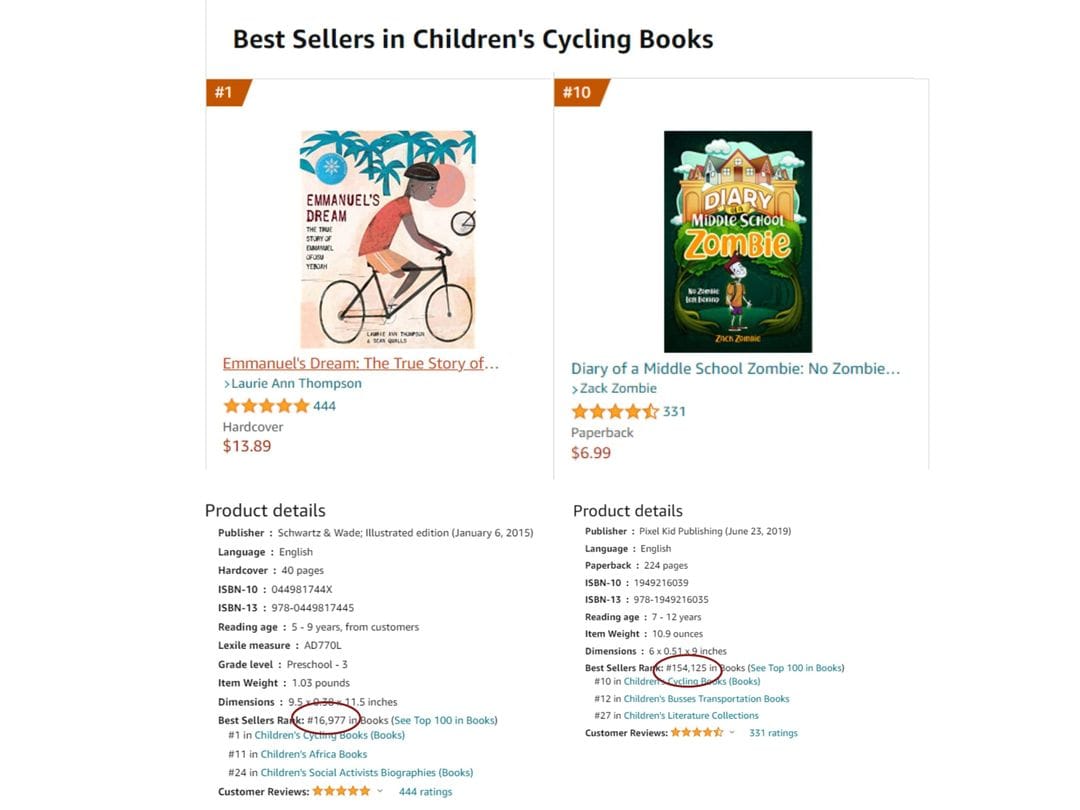
As a category gets more general the number 1 book will have a higher BSR. Utilizing the Amazon BSR is a great way to plan your own categories.
Planning book sales with BSR
One of the benefits of using an Amazon book sales calculator to understand BSR is that it can give an author a good idea of how many books in any given category are sold each month. Certainly, Amazon isn’t the only outlet for book sales, but it is one of the biggest ones, and it can go a long way toward understanding how a book might perform. By checking the BSRs on competitive titles, and author can begin to understand 1) if there is a market for their book and 2) how long they can expect it to take before a book sells a desired number of copies. This information can help authors to plan for how many books to print or even to determine whether a book is worth pursuing.
Pro Tip: When using BSR to predict sales, remember that a lot goes into book sales, and reviewing the BSR should only be one element of your plan. Books or authors that have been on the market longer and have gained a following will have a higher BSR than those just starting out, and authors with stronger marketing campaigns will reflect higher BSRs than those without.
Fact-check book-sale claims with BSR
We’ve all been there: someone wants to sell us on a service, and they do it by making grand claims. Book publishing is no different, and it’s easy for companies to claim that they have brought books to best-seller status, especially if the launch of a book earned a best-seller tag through the use of free eBooks. Before signing on with any service provider who is promising sales, check the BSRs of the books they have worked on. Because BSR isn’t just based on a moment in time but also on a book’s sales history, it tells a good story. The better the BSR, the more consistent the sales are, making it a great avenue for fact-checking any claims made about a book’s success.
Kindle Calculators
Amazon Book Sales calculators are useful, but they only focus on translating Best Seller Rank. Check out these other Kindle calculators to further your Amazon publishing journey.
KDP Printing Cost and Royalty Calculator
Available right on Amazon’s site, Amazon’s printing cost and royalty calculator allows authors utilizing Amazon print on demand to determine how much it will cost to print a book and how much money they will make on each unit sold.
In order to use this calculator, an author will need to know the kind of book being printed (hardcover or paperback), the page count, the kind of paper being used, and a book’s list price. From that, the calculator will provide an estimate on print cost and expected royalty, as well as feedback on the lowest possible list price. Below is an example of an estimate for a standard 32 page picture book.
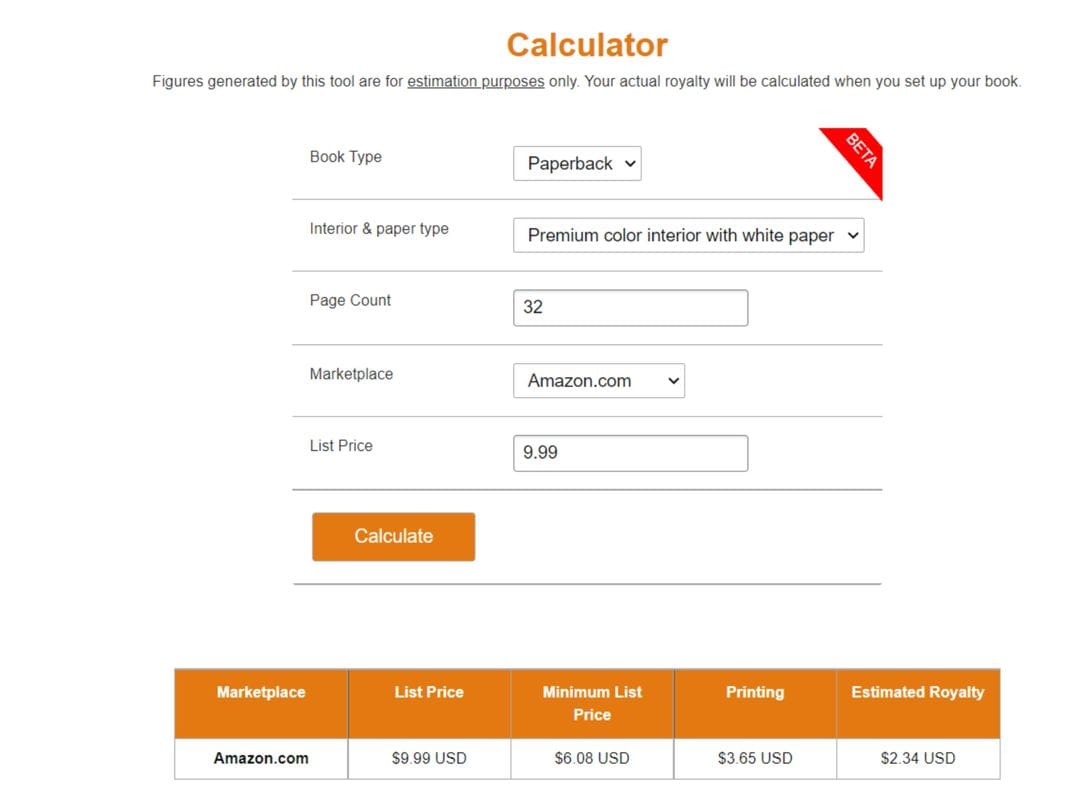
Although Amazon warns that these costs are not final and should only be used as an estimate, they tend to be in line with actual costs, assuming that all of the book’s specs remain the same.
For more information on publishing a book through Amazon, check out my article, How to Publish a Book on Amazon: 10 Steps to Success.
Fulfillment by Amazon Revenue Calculator
Also available on Amazon’s site, the Fulfillment by Amazon Revenue Calculator allows an author who plans to sell non-print on demand books to determine whether it would be more cost-efficient to have shipment fulfilled by Amazon or to fulfill orders directly.
Below is an example of the calculator’s estimates based on a standard 32-page picture book.
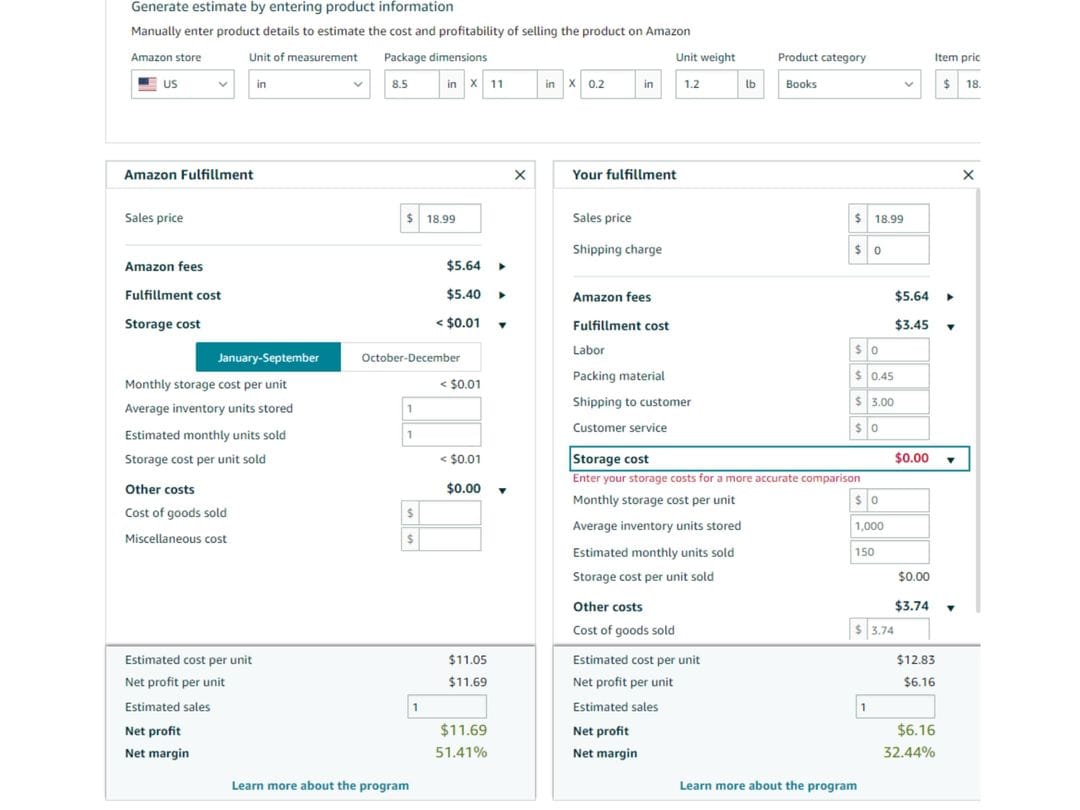
This calculator provides a side-by-side comparison for authors, auto-filling Amazon’s fees on the Fulfilled by Amazon (FBA) side and asking authors to insert their own costs on the self-fulfilled side.
For authors who are unsure how they want to fulfill orders, the Fulfillment by Amazon Revenue Calculator is a great starting point to consider what costs actually go INTO fulfillment, as well as to determine whether books can actually be filled more cost-efficiently without Amazon, or whether it is more cost-efficient to use their fulfillment services.
One thing to note is that this calculator does not factor in the cost of shipping the books TO Amazon to be fulfilled.
Pro Tip: Selling printed books (rather than print-on-demand books) on Amazon requires a Seller Central account, which carries an additional fee of $39.99 per month.